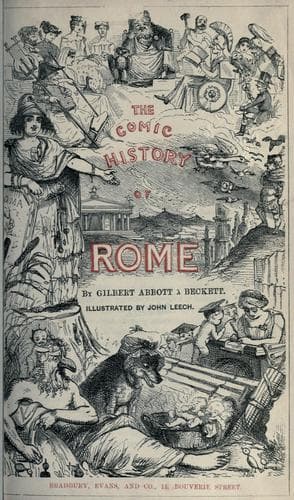
The Comic History of RomeÀ Beckett, Gilbert Abbott
History
The Comic History of Rome
À Beckett, Gilbert Abbott
Rome -- History -- Humor; Wit and humor, Pictorial
The officer on duty, who had arrested the attention of the nurse, being
at length called away by some trifling charge, had left her at leisure
to look after the more precious charge with which she had been
entrusted. As those usually talk the loudest who do the least, the
remonstrances of the female attendant were, no doubt, vehement in
proportion to her neglect; and, indeed, the confusion created by the
shrieks of the nurse was rather calculated to draw off the attention of
the crowd from Virginia herself, who was carried away by Marcus, with an
intimation that he should at once take the case before a magistrate.
Among the other consequences of the neglect of the maid, was an
attachment that had sprung up between the day-school miss and a young
gentleman, named Icilius. This impetuous youth, having heard of what had
happened, proceeded to the court at which the case was about to come on,
and which was presided over by the tyrant Appius. Icilius prayed for an
adjournment, on the ground of the absence of the young lady's father;
and it was found impossible to resist the application of such an earnest
solicitor. This point having been conceded, the friends of Virginia
applied for her admission to bail; and there was such a general tender
of securities among the throng, that Appius felt he could not calculate
on his own security if he refused the request that had been made to him.
The next morning the matter again came on, in the shape of a remanded
case; and Virginius, who had been on duty with his regiment the day
before, was now present at the hearing.
Had there been in those days the same love of the horrible that has
prevailed in our own times, the startling incident of a girl killed by
her own father, would have probably come down to us, through the medium
of the fullest reports, amplified by "other accounts," and a long
succession of "latest particulars." We must, however, on the present
occasion, be satisfied with the merest summary; for the Romans, in the
time of Appius, were equally destitute of relish for the details of the
spilling of blood, and of "family Sunday newspapers," whose respectable
proprietors are always ready to avail themselves of a sanguinary affair,
with an eagerness that seems to show that they look upon blood as
essential to the vitality of a journal, and involving the true theory of
the circulation. It remains only to be told, that Virginius, after
taking leave of his daughter, and finding her escape from the power of
Appius impossible, stabbed her with a knife, snatched up from a
butcher's stall, and, brandishing the weapon in the air, threatened
perdition to the tyrant. Appius, at the sight of the blood-stained
steel, felt his heart fluttering, as if affected by magnetic influence;
and losing, for the time, his own head, he offered ten thousand pounds
of copper for that of Virginius.[21]
Public-domain text, read in full here on John Shaqi.
Reviews
Reviews
No reviews yet
Be the first to share your thoughts on this work.
Elsewhere in the archive
Join the Discussion
Join the discussion
Sign in to leave a comment or review.
Sign InorCreate an account