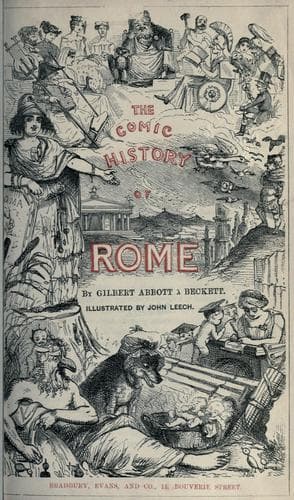
The Comic History of RomeÀ Beckett, Gilbert Abbott
History
The Comic History of Rome
À Beckett, Gilbert Abbott
Rome -- History -- Humor; Wit and humor, Pictorial
_Tribuni militum_, with the power of consuls, were instituted; but the
patricians managed, by a trick, to reduce these consuls into a sort of
stock for their own use, by selecting from their own body two officers
named Censors, who were to be employed in taking the census, an
extremely important part of the consular authority. The mere enumeration
of the people was not of itself a high privilege, and required no
acquaintance with the law, or of any of the twelve tables, excepting,
perhaps, the simple tables of arithmetic. Besides the privilege of
looking after the numbers of the people, the office gave especial
opportunities of looking after number one; for the administration of the
finances of the state was committed to the Censor;[23] and it has too
often happened that a collector of duties has considered that there was
a duty owing to himself, out of those received on behalf of the
Government. They were also Commissioners of the Property Tax, with full
inquisitorial powers; but, most odious part of all, they had authority
to ascertain the dates of the birth of females, as well as males, and
could mercilessly surcharge a lady for her age, as well as her husband
for his income. They were also controllers of virtue and morality, their
duty being to maintain the _mos majorum_, or manners of the old school;
for it seems to have been always the custom of mankind to lament the
past as "the good old times," no matter how bad the old times may have
been, and how infinitely inferior to the present.
The Censors, however, derived their chief influence from their power of
determining the rank of every citizen; for, from the very earliest
times, the multitude were in the habit of pursuing, through thick and
thin, that perilous Will o' the Wisp--a wisp that reduces many a man of
substance to a man of straw--a position in society. This the Censors
could award; and people were ready to pay any price for that most costly
of all stamps--though perhaps, after all, the most difficult to
purchase--the stamp of fashion. From the early days of Rome to the
present hour, we meet with frequent counterfeits of the stamp in
question, the forgery of which has spoiled, and continues to spoil, a
quantity of calves' skin, and asses' skin, that might otherwise be found
of service, at least to its owners.
Public-domain text, read in full here on John Shaqi.
Reviews
Reviews
No reviews yet
Be the first to share your thoughts on this work.
Elsewhere in the archive
Join the Discussion
Join the discussion
Sign in to leave a comment or review.
Sign InorCreate an account