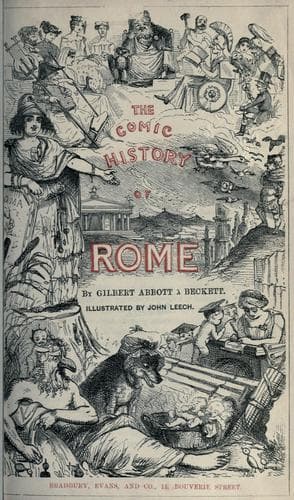
The Comic History of RomeÀ Beckett, Gilbert Abbott
History
The Comic History of Rome
À Beckett, Gilbert Abbott
Rome -- History -- Humor; Wit and humor, Pictorial
Rome had begun to enjoy a short repose, like an infant in its cradle,
when it was unexpectedly made to rock to its very foundations, by a
shortness of provisions; for the absence of anything to eat is sure to
afford food to the disaffected. Grumbling is the peculiar attribute of
an empty stomach; and flatulence, caused by hunger, is an ill wind, that
blows good to nobody. During the scarcity, a wealthy citizen, one
Spurius Maelius, anxious to give his fellow-citizens a genuine meal,
purchased corn at his own expense, and sold it for a mere song--taking
the produce, perhaps, in promissory notes--to his poorer countrymen.
This liberality rendered Maelius extremely popular with all but the
patricians, who declared that they saw through his design in selling
cheap corn; that as old birds they were not to be caught with chaff: and
that his real aim was the kingly dignity. Under the pretext of
preventing him from accomplishing this object, the patricians appointed
a Dictator; and poor old Cincinnatus, bowed down with age and
agriculture, which had been his natural bent, was dragged from the tail
of the plough to the head of the state, though his own state was that of
extreme bodily decrepitude. His Master of the Horse, who really held the
reins, was Servilius Ahala, by whom Maelius was summoned before the
Dictator, to answer any charge that might be brought against him. If the
mode of making the accusation was strange, the method of answering it
was equally irregular; for Maelius, instead of meeting it with dignity,
ran away from it, with a butcher's knife, which he snatched from a stall
in the market-place. Flourishing the formidable weapon, he cut in among
the crowd, and was immediately followed by Servilius Ahala, with a party
of young patrician blades, who, in a manner that would have pierced a
heart of stone, plunged their swords into their victim's bosom.
Ahala was charged with the murder, but he was enabled to avoid the
consequences, as men of consequence in those days could do, by a
voluntary exile. Though domestic cookery had received a check from the
dearth at home, there was no scarcity of foreign broils, and the Romans
created Mam. Æmilius dictator, to encounter the Fidenates and
Veientines. Three ambassadors were sent to Fidenae, but the diplomatic
service could not have been so desirable in those days as in our own,
for the three ambassadors were slain, and perhaps the financial
reformers would say that it was very proper to cut down such a piece of
gross extravagance. The order emanated from Lar Tolumnius of Veii; and
while it said little for his heart, it cost him his head, which was cut
off by Cornelius Cossus--the master of the horse to Æmilius.
Public-domain text, read in full here on John Shaqi.
Reviews
Reviews
No reviews yet
Be the first to share your thoughts on this work.
Elsewhere in the archive
Join the Discussion
Join the discussion
Sign in to leave a comment or review.
Sign InorCreate an account