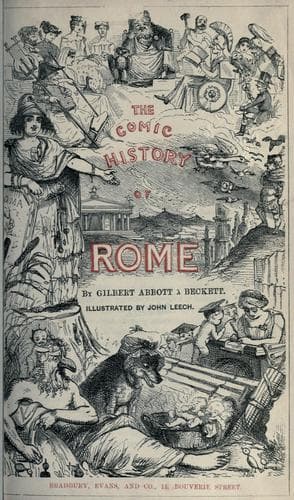
The Comic History of RomeÀ Beckett, Gilbert Abbott
History
The Comic History of Rome
À Beckett, Gilbert Abbott
Rome -- History -- Humor; Wit and humor, Pictorial
The occupants of the Capitol continued to hold out, or rather, to keep
in, and it being desirable to communicate with them, a bold youth, named
Pontius Cominius, attempted the hazardous enterprise. Having encased
himself in a suit of cork, he crossed the Tiber, and clambering on his
hands, he performed the wonderful feat of reaching the Capitol. He
returned in the same manner; and, on the following day the Gauls
observing the track, thought to be all fours with him, by stealing up on
the points of their fingers and the tips of their toes, to the point he
had arrived at. With a cat-like caution, which eluded even the vigilance
of the dogs, and while the sentinels were off their guard, a party of
the Gauls crept up one by one to the top of the rock, which was the
summit of their wishes. Just as they had effected their object, a
wakeful goose,[24] with a head not unworthy of the sage, commenced a
vehement cackle, and the solo of one old bird was soon followed by a
full chorus from a score of others. Marcus Manlius, who resided near the
poultry, was so alarmed at the sound that he instantly jumped out of his
skin--for, in those days, a sheep's skin was the usual bedding--and ran
to the spot, where he caught hold of the first Gaul he came to, and,
giving him a smart push, the whole pack behind fell like so many cards
to the bottom.
Manlius was rewarded with the scarcest luxury the city contained, in the
shape of plenty to eat, and it cannot be said that we have greatly
improved upon the early Romans in matters of the same kind, for a dinner
is still a common mode of acknowledging the services of a public man,
and literally feeding his vanity.
The Gauls continued to invest Rome, and heard with savage delight of the
diminishing supplies, or rather, to use an Irishism, the increasing
scarcity. News at last came that the garrison had been for some time
living upon soles, and it is an admitted fact that they had consumed all
but a few remaining pairs belonging to the shoes of their generals.
Driven at length to desperation, they baked as hard as they could the
flour they still had on hand, and making it up into quarterns, or four
pounders, threw it at the enemy. The Gauls looked up with astonishment,
when another volley of crust satisfied them that bread was coming "down
again;" and not wishing to get their heads broken with the staff of
life, which they fancied must be very plentiful in Rome, they offered
terms of ransom. The price fixed upon was one thousand pounds of gold,
in the weighing of which the Gauls are said to have used false weights,
but it is difficult to say what weight ought to be given to the
accusation. The story goes on to say that the Gallic king, on being
remonstrated with for his dishonesty, cut dissension short with his
sword, and throwing it into the scale with a cry of _Væ victis_, turned
the balance still more in his own favour.
[Illustration: The Citadel saved by the cackling of the Geese.]
Public-domain text, read in full here on John Shaqi.
Reviews
Reviews
No reviews yet
Be the first to share your thoughts on this work.
Elsewhere in the archive
Join the Discussion
Join the discussion
Sign in to leave a comment or review.
Sign InorCreate an account