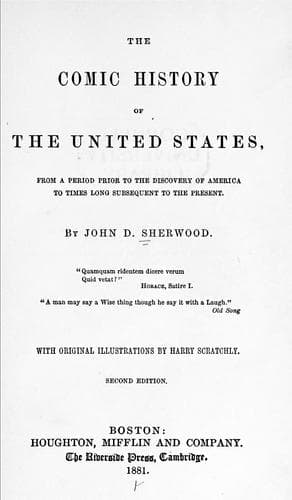
The comic history of the United States, from a period prior to the discovery of America to times long subsequent to the presentSherwood, John D.
History
The comic history of the United States, from a period prior to the discovery of America to times long subsequent to the present
Sherwood, John D.
United States -- History -- Humor
Whole reams of good, white paper might be consumed, as they have often
before been used, and greatly to the advantage of the manufacturer
thereof, in spreading before our readers the various causes of the
American Revolution.
We might collect from dairies North, South, East, and West enough milk
and water to float entire cargoes of reasons and explanations for that
separation which “in the course of human events” is apt to take place
between mothers, even good ones, and daughters, and which is not usually
retarded by the fact, that the mother is selfish, looks to her own
interest exclusively, finds fault with the grown-up girl, and seems
determined to get all the work out of, and to bestow as little as
possible upon, her; and when the girl, on the other hand, is pretty
high-spirited, has plenty of beaux, friends, and good health, and a
nice, comfortable property of her own. We might, we repeat, collect all
this ocean of milk and water together; but upon taking counsel of our
own experience, we have concluded to condense this troublesome mass into
a few panfuls of cream, which will, we feel sure, contain all the
substance, richness, and compressed value of the entire sea. Skimming
over the wide surface, we obtain, then, these creamy globules, the round
causes of the American Revolution.
_1st Cause._—The people,—the _causa causas_,—the yeast, whose
fermentation in the pots, placed in various American chimney-corners,
raised off their lids and opened their owners’, to see their own rights
and interests.
_2d Cause._—George Washington, Samuel Adams, Patrick Henry, Benjamin
Franklin, Thomas Jefferson, Joseph Warren, John Rutledge, James Otis,
Henry Laurens, and a few others, without whom the fermenting-pots might
have “run to emptyings.”
_3d Cause._—The duties vainly sought to be raised by George III. from
the colonists, and which unexpectedly raised duties in them, that fitted
them, not with, but to, a T.
_4th Cause._—The glimpses obtained during those stolen colonial
courtships, in 1754, 1765, and 1774,—those sly unions at Albany, New
York, and Philadelphia,—of the fuller blessings and happiness of “a more
perfect Union.”
_5th Cause._—The identities of language, interests, love of liberty,
capacities for legislation and home control throughout the various
Colonies, and the felt unwisdom of looking three thousand miles for what
they could better find at home.
_6th Cause._—George III., Lord North, and Charles Townshend.
_7th Cause._—The British Navigation Acts, which prevented American
navigation and dried up the Atlantic for American bottoms.
By these heavy machines the seas were made all up hill to American, and
easy down hill for English ships.
_8th Cause._—The colonial assemblies, where Americans learned their own
country dances, and unlearned the court quadrilles.
_9th Cause._—The strong Saxon dislike of impositions which had
accompanied the emigrants hither as a principle, and was always kept
here, both principal and interest.
Public-domain text, read in full here on John Shaqi.
Reviews
Reviews
No reviews yet
Be the first to share your thoughts on this work.
Elsewhere in the archive
Join the Discussion
Join the discussion
Sign in to leave a comment or review.
Sign InorCreate an account