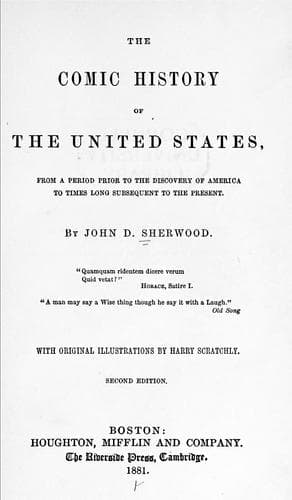
The comic history of the United States, from a period prior to the discovery of America to times long subsequent to the presentSherwood, John D.
History
The comic history of the United States, from a period prior to the discovery of America to times long subsequent to the present
Sherwood, John D.
United States -- History -- Humor
Both parties now retired to their corners, the Frenchman pretty well
exhausted, Mr. Bull just getting warmed up to the fight, and both, if
possible, more infuriated than ever. Each was thoroughly sponged, and on
time being called for the sixth round, in 1759, John Bull strode
completely across the ring to the spot which his adversary had chosen,
glaring like a very Wolfe. He had tasted blood, his own was up, and his
leonine nature was roused for a crushing spring. Quickly and rapidly he
planted a blow between the Gaul’s blue eyes, breaking the bridge of his
nose at Point Levi. To evade this blow, the Gaul leaped back and
attempted to parry it, and at the same time to inflict upon his enemy
another Montcalm settler; but quick as thought Mr. Bull, heavy as he
was, sprang upon a small mound called the Plains of Abraham, and there,
swinging his sinewy arm high in the air, brought down his ponderous fist
full upon the Frenchman’s head. Staggering backwards to the ropes, the
Celt fell headlong, bloody and cruelly hurt.
[Illustration:
THE CHAMPIONSHIP FOR THE AMERICAN BELT.
(p. 227)
]
To the on-lookers it was manifest that the hot contest was virtually
decided; but a resentment that pulsed through every vein urged the
Frenchman to a few more unsuccessful efforts. Coming up slowly to the
summons in the three last rounds, in 1760, 1761, and 1762, just making
time and saving himself from the confession of defeat, he sank down at
the end of the ninth round, spent in spirits and strength, but vexed and
angry with his adverse fortune. A herald, advancing in the centre of the
ring, proclaimed that Johnny Crapeau withdrew his claim to the belt,
only stipulating, in consideration of the past, that he might keep a bit
of the fringe off its western end.
John Bull, picking up the coveted prize, announced in a bluff, resolute
voice to the by-standers that the young lady, with the belt, dower, and
expectations, all now passed to him forever.
Future chapters will show how little he knew of the maiden whom he
claimed to have won.
Meanwhile Jean Crapeau signed and delivered to his English victor a
release of all his claims to the damsel’s lands lying east of the
Mississippi.
CHAPTER XIII.
CAUSES OF THE AMERICAN REVOLUTION.
The People as Yeast.—The Fermentation.—Washington, Samuel Adams, Patrick
Henry, Rutledge, Franklin, Otis, and others, and their Value in the
Colonial Fermenting-Pots.—State Courtships in 1754, 1765, and 1774,
tend to a more Perfect Union.—How Home Confidences operate.—What
Effect the English Navigation Acts had on American Swimmers.—Lord
North and Charles Townshend.—Colonial Assemblies and Country
Dances.—Dislike of Impositions.—That small Boston Tea-Party.—The large
Amount of Atlantic Water between the Tea Seller and Tea
Purchaser.—When Tea can’t be sweetened.—Be-cause as a Cause.
Public-domain text, read in full here on John Shaqi.
Reviews
Reviews
No reviews yet
Be the first to share your thoughts on this work.
Elsewhere in the archive
Join the Discussion
Join the discussion
Sign in to leave a comment or review.
Sign InorCreate an account