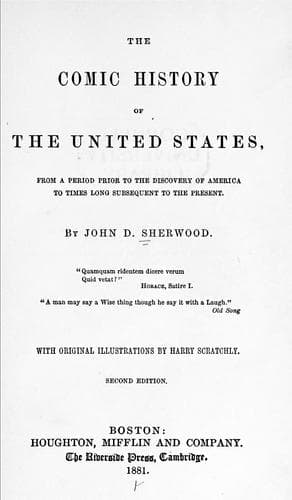
The comic history of the United States, from a period prior to the discovery of America to times long subsequent to the presentSherwood, John D.
History
The comic history of the United States, from a period prior to the discovery of America to times long subsequent to the present
Sherwood, John D.
United States -- History -- Humor
and stung them.—Where the Jolly Dogs then went.—The Wheel well
started.
[Illustration: BRITANNIA FORCES TEA ON HER TROUBLESOME CHILD.]
There is always a strange curiosity to see an express-train go by.
Everybody crowds up to witness the great red eye glare and scowl, as if
it resented the safe inspection which those on the platform give it, as
it rushes past. Every one, young and old, watches, with concentrated
interest, the momentarily visible heads of the passengers, dusty,
dishevelled, and hot, seen through the passing windows, as the train
pants, hurrying around a curve, into the darkness. Not a little of the
interest is enhanced by the feeling that it will bring up safely far
away in a metropolitan depot, and there decant its well-shaken,
effervescing freight.
So stand we, surrounded by our readers, on the platform of history, to
see the American Revolution rush along upon its own way, grim, earnest,
resolute, tracking its onward march towards the great end for which it
set out.
“Le genie,” says Buffon, “c’est la patience.” If the naturalist’s
definition be true, the colonial patience constituted a most remarkable
exhibition of genius.
In 1763 the greater part of the colonists were the descendants of men
who had escaped from hard civil and ecclesiastical exactions in their
home lands, and had set up for themselves in an unappropriated field.
From this new lot they sought to extract, by the difficult labor of one
hand, its reluctant yield for subsistence, and by the other to keep off
from it enemies ready to take and cut their crops. Uninvited pensioners,
called Governors, were soon sent out, in showy tinsel, to tithe their
laboriously earned products, and to fence in by golden bars wrought by
the settlers the royal prerogatives and pretensions, from which those
settlers had endeavored to rid themselves by self-exile. In some of the
Colonies mint and cummin were extracted for a church, between whose
ecclesiastical detectives and themselves they had essayed to put three
thousand miles of disagreeable pickle, with rods enough in it to terrify
even lean curates with little to throw up. The English civil list,
portioned off upon the young emigrants in the shape of office-holders,
sucked up—like an old toper in a newly established tavern—the very best
that the place afforded. These officials thus suffered at first to
partake of the generous, open-house entertainment, soon cast around them
to effect a permanent claim for free commons, where they had been only
tolerated by an unselfish hospitality. As no one likes to be eaten out
or evicted from his own house and home, even by assumed and softly
spoken friends, these self-imposed guests were naturally regarded as
poor, proud relatives, who came unbidden at first, put on company airs,
insisted on company fare, needed extra waiting on, bred disaffection
among the servants, and set up the children to fancies beyond the
parental means or authority.
Public-domain text, read in full here on John Shaqi.
Reviews
Reviews
No reviews yet
Be the first to share your thoughts on this work.
Elsewhere in the archive
Join the Discussion
Join the discussion
Sign in to leave a comment or review.
Sign InorCreate an account