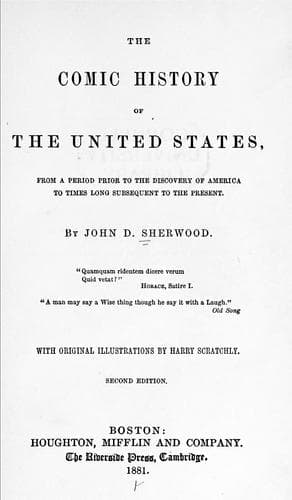
The comic history of the United States, from a period prior to the discovery of America to times long subsequent to the presentSherwood, John D.
History
The comic history of the United States, from a period prior to the discovery of America to times long subsequent to the present
Sherwood, John D.
United States -- History -- Humor
The Navigation Acts, to which we have already adverted, which sought,
contrary to all equity, right, or decency, to compel the poor fugitives
from plenty and power to send away their scanty surplus of corn, and to
get what few things they needed and could afford with difficulty to
procure, oceanwise, and in vessels exclusively owned, built, manned, and
officered in England, were standing grievances. They were so hard and
stiff, that every one ran against them, and after picking himself up,
looked back at them in very bad humor and with adjectives which in such
moments some utter, but which types refuse to immortalize.
Poor fowls breed rapidly. The Navigation Acts soon laid other vicious
eggs. On the restoration of the monarchy in the person of Charles II.,
in 1660, the colonists were still further tied up by an act which
restricted them in the disposition of their salable products to England
alone,—a very desirable thing for English purchasers, but deemed by the
pinched colonists rather rough upon them. The affectionate
step-children, however, overlooked this selfishness of the cross-grained
old step-mother, and clung with romantic attachment to the dear old
homestead, from which they got nothing but cheap messages of cunning
endearment, in return for the substantial contributions which were taken
back in the Thames-built clippers.
These acts of Parliament were of course floored with thick, wide
planking of well-jointed terms, and roofed in with a royal signature,
which in English, and especially in colonial eyes until opened, made
even thin shingles shine like stars; but for all this parliamentary
carpentering the gales and storms of real life soughed and swept in
through the clapboarding, sometimes chilling, and sometimes wetting, the
colonial tenants.
Colonial lands, too, were given away as loosely and as liberally as by
Congress now; then to royal, as now to railroad, favorites. A commercial
strabismus, or English squint-eyedness, was sought to be made
fashionable in the North American communities, just as now prevails in
Canada,—an apparent look at their own interests in one direction, while
in fact by this crooked optical inversion, the eye is all the time
looking intently in quite another quarter. That direction was of course
northeastwardly towards those little specks of islands, that were left,
in the miscellaneous creation of things, near the outer rim of Europe,
and so diminutive, that the very strain to discover them behind piles of
parliamentary selfishness and supports, huge stacks of manufactured
iron, steel, cotton, wool, and puffy conceits, was sure to injure the
sight and at last to produce qualms and nausea.
Public-domain text, read in full here on John Shaqi.
Reviews
Reviews
No reviews yet
Be the first to share your thoughts on this work.
Elsewhere in the archive
Join the Discussion
Join the discussion
Sign in to leave a comment or review.
Sign InorCreate an account