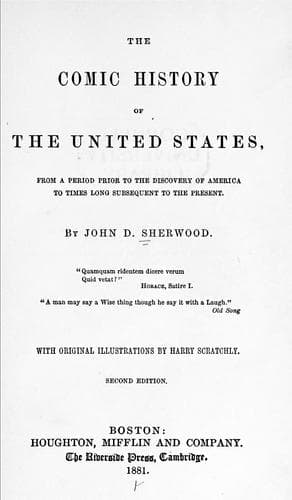
The comic history of the United States, from a period prior to the discovery of America to times long subsequent to the presentSherwood, John D.
History
The comic history of the United States, from a period prior to the discovery of America to times long subsequent to the present
Sherwood, John D.
United States -- History -- Humor
As long as France stayed in the American schoolhouse there were two big,
full-grown bullies, whose mutual jealousy and antagonism were the best
protection of the children from either; but after the overthrow of M.
Jean Crapeau in 1763, Mr. Bull thought that he could have things just as
he pleased, could sit down where he liked, in such gear as he chose to
make himself comfortable in,—shirt-sleeves or hunting-coat, muddy or
indecently short,—could eat up any one’s lunch if he fancied, and munch
the choicest fruit that the youngsters were keeping for their own use at
play-time. And so, by a law of bullyism,—which is human nature ossified
by success,—the moment of the triumph over the one standing champion,
was the moment when the intoxication of fancied supreme power, producing
a vertigo of insolence, brought out around the object of the
championship rivals never before suspected.
In a word, by slow and painful training, the Colonies had become their
own champions.
The very year that saw the treaty of peace signed between France and
England, by which the former gave up all her American possessions east
of the Mississippi, and resigned the belt of North America to the
latter, George Grenville, the English minister, gave notice that he
should introduce into Parliament a bill to oblige every colonist, who
used in any way receipts, notes, drafts, leases, deeds, mortgages, or
any such crafty documents, to buy from the British government and put
upon them stamps, the proceeds of which sale was to be spent, of course,
not among the colonists themselves, but in England, in paying the
national debt or in some other facetious way. Of course, Americans did
not object to stamps in themselves, provided they helped to make or to
hold the die which printed them, and had a hand in grooving and
directing the channels in which the pay for them should flow. But they
did object—and as the event proved most sanguinarily—to the slicing of
their family loaf by a parliamentary knife called a stamp act, sharpened
on a London stone, and whittling off their living even with the sparing
charity of the Bull family. They did not think it either safe or right
for any Taurian, or Teutonic, or Gallic chap, however gentlemanly in
manners or benevolent in professions, to be trusted in the pantry, there
to use to any extent what he might find, whether articles of luxury, as
pies or other poisons, or necessities, as bread, butter, cider, or other
field distillations.
Public-domain text, read in full here on John Shaqi.
Reviews
Reviews
No reviews yet
Be the first to share your thoughts on this work.
Elsewhere in the archive
Join the Discussion
Join the discussion
Sign in to leave a comment or review.
Sign InorCreate an account