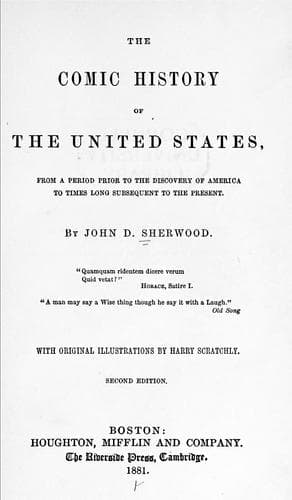
The comic history of the United States, from a period prior to the discovery of America to times long subsequent to the presentSherwood, John D.
History
The comic history of the United States, from a period prior to the discovery of America to times long subsequent to the present
Sherwood, John D.
United States -- History -- Humor
The bill of Mr. Grenville was a little one,—very small and very
timid,—but there was a bird behind it, as large as all the English crows
and jackdaws put together. The bird was not introduced until the next
year, 1764, when it was tricked off with some bright beads and spangles
around its neck, to disguise its genus. But many in England discovered
immediately that it belonged to the family _Falco Britannicus_, the
genuine old-fashioned British falcon, with strong, sharp claws and
curved short bill to seize, and long, powerful wings to bear away across
seas, the colonial prey. It is a bird now shot at by every philosophic,
well-charged English muzzle whenever it makes its appearance; but at the
time of which we speak there were public game-keepers of the Grenville
kind, not only in England but in other countries, who believed in
training and keeping up the breed of parliamentary or royal falcons for
colonial and also for home service. These well-fed keepers stoutly
maintained that it was right for these fowls, deigning to leave their
royal perches in Hesse or Hanover, to alight for their royal pleasure
upon private barn-yards and in granaries, and that the people were
proper game and profitable sport, and should even feel honored by the
eagle-like visits.
It was thought best, however, by the English huntsman of state to send
across the Atlantic and exhibit here specimens of the fowl. Patrick
Henry, Samuel Adams, James Otis, Richard Henry Lee, and others, well
acquainted with the game and domestic birds of North America, at once
pointed out and denounced the cruel spurs which this short-billed,
sharp-clawed British falcon wore. Others, if possible more outspoken,
declared their opinion that this bird never could be domesticated on
this side the water, but would get its spurs cut away and perhaps its
well-feathered neck wrung, whenever it was sent over for real use among
the colonists.
Meanwhile, Mr. Bull declared that the colonists should not have any
molasses to lick, unless he himself brought it and sold it to them. Of
course from that time forward New England people got to love molasses
with patriotic obstinacy, and above all things liked to tickle it with a
straw out of those very solemn-looking and otherwise forsaken casks,
lying in the neglected custom-houses at Boston, Salem, Newport, and New
Haven.
In 1765, the new bird was brought over full-fledged, guarded by numerous
fowl-fanciers, who watched it vigilantly on both sides, as the lion and
unicorn are represented watching the British crown. But as usual,
American quickness to its own interests was quite equal to British
selfishness, and, ere the heavy guardians could turn around to see who
of the many spectators was teasing and worrying the bird, his feathers
were dreadfully plucked, and the poor thing left with exposed claws and
crooked bill to the keen ridicule of the by-standers.
Public-domain text, read in full here on John Shaqi.
Reviews
Reviews
No reviews yet
Be the first to share your thoughts on this work.
Elsewhere in the archive
Join the Discussion
Join the discussion
Sign in to leave a comment or review.
Sign InorCreate an account