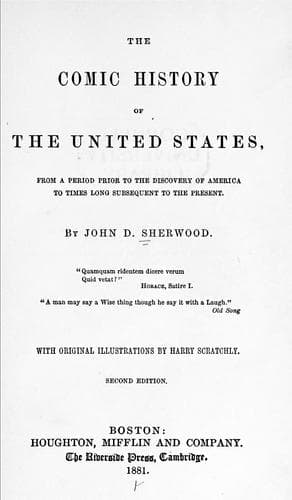
The comic history of the United States, from a period prior to the discovery of America to times long subsequent to the presentSherwood, John D.
History
The comic history of the United States, from a period prior to the discovery of America to times long subsequent to the present
Sherwood, John D.
United States -- History -- Humor
Major-General Charles Lee, a Welshman by birth, and a soldier of
fortune, who had fought in Portugal and Poland, mettlesome and waspish
in temper, was despatched in April with other troops to New York, where,
after a neck-and-neck race with Sir Henry Clinton, accompanied by a
large British force from England, he arrived only two hours before his
competitor. Sir Henry, although anxiously expected on shore by several
British friends, at length concluded that it was too early in the season
to alight so far north, and so cruised southward for a milder climate
and reception. Sailing leisurely down our wave-dented shores, he joined
the squadron of his old boon companions in arms, Admiral Sir Peter
Parker and Earl Cornwallis, with some two thousand five hundred jolly
dogs, hired at fourpence a day to come out and inspect our country.
Strolling on together pleasantly in a warm latitude, with flying-fish to
amuse them on the outside, and broiled fish inside the ships, they
touched land at last near Charleston. The restless, waspish Lee, who had
been also flying down southwards over the land, hovering on quick wing
and watching the jolly dogs to see where they would come ashore, no
sooner found that they thought of landing at Sullivan’s Island, and
visiting a military summer-house there, built of palmetto wood, and
called Fort Moultrie, than he lit upon them, stung two hundred of them
more or less uncomfortably, and compelled them all to go off wholly from
that place, the pleasure of reaching which depends so much upon the
feelings of those to whom the visit is proposed.
New England and the South were now alike freed from British tourists and
German musket-holders.
Where Sir Henry and his jolly dogs, constituting one party, and Lord
Howe with his lively squad, still enjoying themselves at Halifax after
their rapid journey from Boston, making up the other British set, would
next prospect, much concerned the Continental Congress, George
Washington, Charles Lee, and the colonial people generally. The
uncertainty was soon ended. Lord Howe, sailing from Halifax, June 11th,
reached Sandy Hook on the 25th of the same month, and dropping anchor
off Staten Island, July 2d, was soon joined by Sir Henry and his jolly
dogs, feeling a little uneasy of stomach, and somewhat less merry than
when they left England nearly three months before, and vowing, ’pon
honor, that Sir Henry had somewhat taken them in at Charleston,
although, in fact, the real trouble was that he had not taken them in at
all there.
Truly the Revolutionary wheel was now well started, and began to get in
earnest motion.
CHAPTER II.
JULY FOURTH, 1776, AND SO FORTH.
Public-domain text, read in full here on John Shaqi.
Reviews
Reviews
No reviews yet
Be the first to share your thoughts on this work.
Elsewhere in the archive
Join the Discussion
Join the discussion
Sign in to leave a comment or review.
Sign InorCreate an account