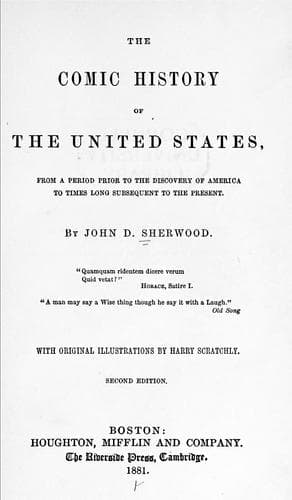
The comic history of the United States, from a period prior to the discovery of America to times long subsequent to the presentSherwood, John D.
History
The comic history of the United States, from a period prior to the discovery of America to times long subsequent to the present
Sherwood, John D.
United States -- History -- Humor
He fell, however, as those fall who do more than achieve
success,—deserving it. Under the portico of St. Paul’s Church, in the
city of New York, at the confluence of those pulsing streams of life
which surge down Broadway and the Bowery,—gathering a volume
sufficiently strong to overcome the heavy whirlpools of Wall Street,—lie
what of Richard Montgomery was mortal, borne thither sixty-three years
after his death by his grateful fellow-citizens, who have laid on the
island of Manhattan, now glittering with superb edifices, no
corner-stone nobler or more imperishable than that which they then
deposited.
The Revolutionary wheel had now fairly started, and one of the first
results of its motion was the shaking off those dusty particles, the
royal governors,—Dunmore, in Virginia; Lord William Campbell, in South
Carolina; Sir Joseph Wright, in Georgia; and others,—each of whom,
measuring his own weight on his own scales, fancied—as we now can read
in their despatches to the Colonial Office—that he was himself a stone
large enough, if dropped in front of the wheel, to stop forever its
further advance.
The Hessian bees, shaken off the home twigs by their owners, the fussy,
poverty-ridden dukes, princes, landgraves, and margraves, swarmed over
and settled at Boston on the oaken boughs planted there by Lord Howe.
George Washington was determined to make a vigorous effort to break up
the hive and to get its military honey. In March, 1776, he drew near to
Boston, sitting down on Dorchester Heights with an earth curtain before
him, to guard against the stings of any vagrants that might stray away
from the main swarm. Scarcely, however, had our general, in his buckskin
breeches, begun to feel around the nest, before, to his great surprise,
and to the infinite wonderment of George III., and his minister, Lord
North, the entire swarm with a peculiar buzz, rose at four o’clock in
the morning from their new-made hive and flew away in a bee-line for
Halifax. Much honey, then particularly dear to Americans, was gathered
after they left; as much as two hundred and fifty combs, in the shape of
cannon, and not a little of that bee dust, so very scarce in March,
1776, called powder. Washington was much concerned lest the pesky swarm
might turn their flight and settle down in New York. So, after attending
a lecture the night following his entrance into Boston, in order not to
excite by his absence any hubbub in that literary and then religious
place, he set in motion the great body of his troops towards the island
of Manhattan.
Public-domain text, read in full here on John Shaqi.
Reviews
Reviews
No reviews yet
Be the first to share your thoughts on this work.
Elsewhere in the archive
Join the Discussion
Join the discussion
Sign in to leave a comment or review.
Sign InorCreate an account