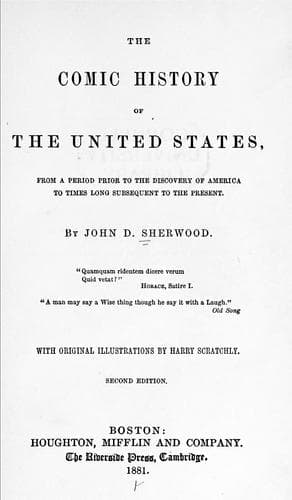
The comic history of the United States, from a period prior to the discovery of America to times long subsequent to the presentSherwood, John D.
History
The comic history of the United States, from a period prior to the discovery of America to times long subsequent to the present
Sherwood, John D.
United States -- History -- Humor
While the wise men at Philadelphia were making the Fourth of July a
precedent for the future by their very readable and taking Declaration
of Independence, the English kites were gathering from the north, south,
and east around New York. Lord Howe, from Halifax; Sir Henry Clinton,
from Charleston; and Admiral Howe, from England, drawn together by
focalizing orders, settled down with their separate flocks on Staten
Island,—one of the lintels of the gateway to the metropolis,—numbering
together twenty-four thousand old hawks which had often whetted their
beaks before in Spanish, German, and Dutch blood.
Washington had about seventeen thousand agricultural lads, armed with
every possible and impossible accoutrement, contrivance, and weapon, to
watch the well-trained brood. Lord Howe, being a royal commissioner as
well as a general, understood letter-writing well; and his first care
was to pen an epistle to the American commander. Upon its composition he
bestowed as much care as a young man upon his first letter to the coy
damsel whom he would conciliate; but upon the address he spent far
greater pains. As despatched, it read “George Washington, Esquire.”
Carried to the General, he declined to receive it. Not that he was not
an “Esq.,” for all Americans are born such of course; but being a Squire
in a military court whose proceedings were likely to be recorded, he
conceived himself to be entitled to different honors.
Defeated in his pen addresses, the British general tried another stroke.
On the 22d of August, 1776, landing on Long Island, he commenced a march
by three separate detachments towards Brooklyn, which, after a severe
battle on the 27th of August, he took. It was the first invasion by the
Germans of that quiet, pleasant, New York dormitory. Then the
inhabitants took it very hard. Now, however, they have become so much
accustomed to the German irruptions, that they have ceased to be
astonished at their own frequent captures. We may add that the Hessians
did not at that time elect Herr Martin Kalbfleisch mayor of Brooklyn.
They waited nearly ninety years, and then returned, not to their mutton,
but to their veal.
Public-domain text, read in full here on John Shaqi.
Reviews
Reviews
No reviews yet
Be the first to share your thoughts on this work.
Elsewhere in the archive
Join the Discussion
Join the discussion
Sign in to leave a comment or review.
Sign InorCreate an account