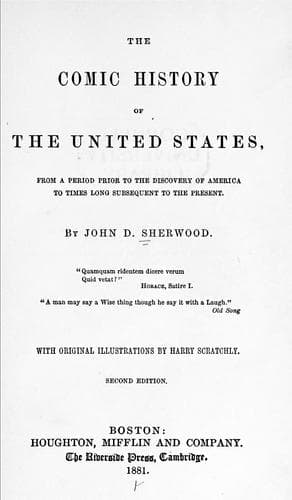
The comic history of the United States, from a period prior to the discovery of America to times long subsequent to the presentSherwood, John D.
History
The comic history of the United States, from a period prior to the discovery of America to times long subsequent to the present
Sherwood, John D.
United States -- History -- Humor
The gathering in of one thousand dead and wounded from the Long Island
hills was not the kind of harvesting that the agricultural lads
expected; and as they had only engaged for a short job, many of them
went back on the 28th to their own farms. Washington not liking to be
sandwiched with the rest of his forces, numbering some fourteen
thousand, between Howe’s Germans and the East River, contrived during
the misty night of the 29th of August to get over the river to New
York,—an exploit much vaunted then among military men, but rendered very
easy in our time by the Union Ferry Company’s boats. The country
recruits who are now transported every Sunday across the same river to
Beecher’s church, when there again transported, and after the service
transported back again, show what changes have occurred in the
facilities for moving large bodies of men over the East River since the
battle of Long Island.
Howe’s Hessians threatening to emigrate en masse to New York, General
Washington, on the 10th of September, made room for them by taking his
young army to the upper part of Manhattan Island, giving them an
opportunity to see the rustic beauties of Harlem and the country around
the present High Bridge. As it sometimes happens in war, as well as in
peace, that different gentlemen take a fancy to the same piece of
ground, whose possession and value are enhanced thereby, General Howe’s
desire to become possessed of the same real estate in the actual
occupation of Washington, reached such a pitch that he sent a large
party of military friends to seize it, even if by so doing they were
obliged to dispossess its occupant. The friends of the Squire, however,
resented this violent attempt so spiritedly that, as it has often fallen
out since, the visitors to Harlem went back to New York with very red
eyes and faces unkindly disfigured.
Lord Howe next attempted to get around the Squire by sending a part of
his force, now increased to thirty-five thousand men, into the lower
district of Westchester to see how Harlem and the Continentals looked
from the rear, and the other part on a lively picnic up the Hudson
River; but the wary leader of the Americans had seen, when surveying or
hunting in Virginia and Ohio, too many traps set by Indians and white
trappers to be caught between the steel jaws of this English one. So he
pulled his men away from the cautiously planted contrivance and took
them several miles to the northeast, on the Bronx River. He allowed
several of them, however, to go up to White Plains, where, to his
chagrin, they were set upon by a large British party and very
disagreeably handled.
Public-domain text, read in full here on John Shaqi.
Reviews
Reviews
No reviews yet
Be the first to share your thoughts on this work.
Elsewhere in the archive
Join the Discussion
Join the discussion
Sign in to leave a comment or review.
Sign InorCreate an account