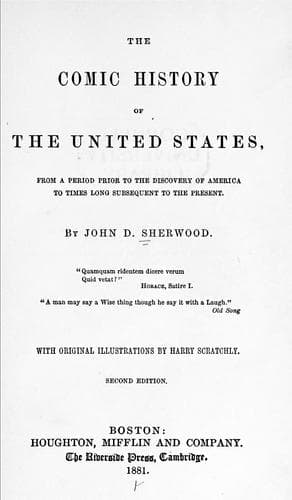
The comic history of the United States, from a period prior to the discovery of America to times long subsequent to the presentSherwood, John D.
History
The comic history of the United States, from a period prior to the discovery of America to times long subsequent to the present
Sherwood, John D.
United States -- History -- Humor
Even in England thousands of hearts warmed to the American cause. In
Parliament, Charles James Fox, Earl Chatham, Edmund Burke, the virtuous
Lord Camden, and others; out of it, David Hume the historian, Edward
Gibbon, whose studies of the rise as well as the fall of Rome had led
him down into the crypt of history, and countless able, learned, and
good, others as true to state as to individual freedom, gave vent and
weighty shape to the well-considered convictions of the injustice of the
attempt to compel the Colonies to submit to impositions unassented to by
themselves. But while in England there were advocates of colonial
freedom, in the Colonies there were friends of Parliamentary oppression.
These last were infiltrated more or less through all the United
settlements; but they gathered in notable volume in and about the then
considerable village of New York,—numbering about 26,000
inhabitants,—where all the vigilant zeal of Alexander Hamilton, an
ardent, eloquent young lawyer, recently arrived from his native West
Indies, the equally vigorous but cooler patriotism of John Jay, and the
alert wisdom of other Sons of Liberty were needed, to make head against
the Tory current whose momentum and velocity, quickened by wealth,
social position, and official experience, swept with force and volumed
power through the island city. Rude indeed was the shock given to the
Manhattan loyalists by the overthrow in the Bowling Green of the leaden
statue of George III., and the conversion of its characteristically
heavy metal into lively Continental bullets. The popular repeal of this
loyal statue was soon followed in Congress by the repeal of more
important representatives of royalty,—leaden-typed statutes.
The year 1777 opened with the battle of Princeton, fought under the
leadership of Washington and Cornwallis, whereby two hundred English and
Germans were put under sodded trenches, to furnish in after times, in
addition to their use in well-rounded school-boys’ periods, a special
resort for the students of Nassau Hall, accompanied by such persuadable
female companions—Dutch, American, English, or German—as might relish
history studied under the advantageous lights of a pair of admiring
eyes.
Public-domain text, read in full here on John Shaqi.
Reviews
Reviews
No reviews yet
Be the first to share your thoughts on this work.
Elsewhere in the archive
Join the Discussion
Join the discussion
Sign in to leave a comment or review.
Sign InorCreate an account