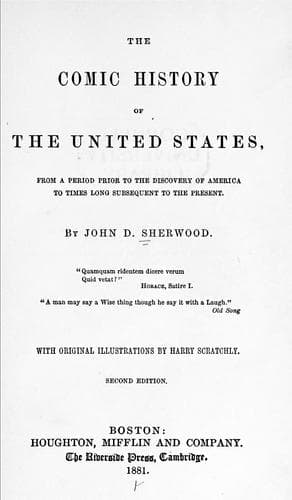
The comic history of the United States, from a period prior to the discovery of America to times long subsequent to the presentSherwood, John D.
History
The comic history of the United States, from a period prior to the discovery of America to times long subsequent to the present
Sherwood, John D.
United States -- History -- Humor
Christmas eve, 1776, was a very jolly one in the British camp. The
commander, officers, and men, all thought that the American fiddle was
broken and about to be hung up forever; and so, in their Saxon and
Teutonic joy, they hung up their stockings. The shrewd American Squire,
borrowing old Santa Claus’s coach and horses, and filling the former
with bullets and powder, crossed the Delaware about midnight and
suddenly dropped his presents through the camp of his foreign visitors.
Never were the Hessians so taken by Christmas gifts. In fact, fourteen
hundred of them were so overcome by the novel presence of Washington,
that they gave themselves up to American hospitality and followed their
new friends across the river to their now merry quarters.
The American fiddle was mended again; and its strains of Yankee Doodle
were heard across the Atlantic by a young French marquis, only nineteen
years of age, of a very old family, with a very young wife, and an
income of $40,000 a year,—an income in those pre-Erie and pre-petroleum
times highly respectable. Other Frenchmen also listened to, and, like
Lafayette, were moved by, the touching airs of freedom, which passed the
Rhine also, and were drunk in with his hock by the Prussian Steuben, a
military martinet and schoolmaster, much needed in our militia
schoolhouse. The Baron was then generalissimo of his serene,
discomposable highness, the Prince of Hohenzollern-Hechingen, whose
magnificent titles would, if printed on a straight strip of paper, have
easily reached across his principality; but sounding as they were, they
did not fill the ear of Steuben like the notes from that repaired
fiddle. The lively adagio airs also struck upon the sensitive vibrating
soul of De Kalb, a noble of Alsace, lifting it to highest impulses,
which carried him through four years of patriotic service, and even bore
him in lofty triumph across the death channel in 1780, when at the
battle of Camden he was carried away from the daring front, loaded with
eleven bullets in various parts of his body.
These same free airs fell upon those straight, upright Poles, Kosciusko
and Pulaski, and so vivifying them by warming heats, that through the
whole war they bore most fragrant fruit, until at last they stood as
that vintage so ripely planted in Mrs. Browning’s verse,
“Where the sun with a golden mouth doth blow
Blue bubbles of grapes down a vineyard row,”—
the blue grapes of blistered steel.
Public-domain text, read in full here on John Shaqi.
Reviews
Reviews
No reviews yet
Be the first to share your thoughts on this work.
Elsewhere in the archive
Join the Discussion
Join the discussion
Sign in to leave a comment or review.
Sign InorCreate an account