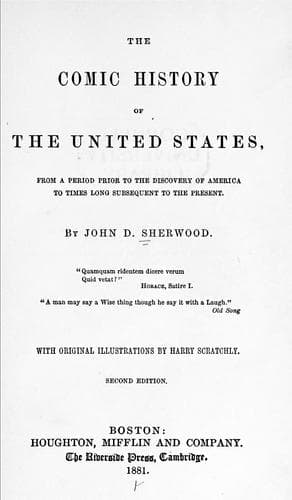
The comic history of the United States, from a period prior to the discovery of America to times long subsequent to the presentSherwood, John D.
History
The comic history of the United States, from a period prior to the discovery of America to times long subsequent to the present
Sherwood, John D.
United States -- History -- Humor
Towards the South the war now turns. The French and English fleets,
having sailed for the West Indies, thus relieving Sir Henry Clinton of a
natural anxiety about New York, he despatched thence, in November of the
same year, a force of two thousand men against Georgia. Savannah, just
then preparing to receive her first bran-new city charter, and feeling
like a boy who is promised his first pair of long pantaloons to cover
his lengthening proportions, was taken in hand by Clinton’s military
schoolmaster and humiliated by a gentle spanking. Her sandy bottom,
however, stood the trouncing well. She had the hardihood even to look
right pleased and content when it was soon after told her that an
expedition sent out against Port Royal, South Carolina, had been soundly
ferruled.
The year 1779 opened with, and shut upon, a lively guerrila war, carried
on through Georgia and South Carolina by small bodies of troops, so
light as almost to seem feathered, led by Moultrie, Pickens, and other
partisan officers, who teased and worried the enemy by incessant
scratches and irritating stings, especially annoying in the summer-time
and amid a warm climate.
[Illustration:
PUTNAM’S HOME-STRETCH DOWN HORSE-NECK.
(p. 293)
]
At the North the British forces spent themselves on small excursions out
of New York, very much as many people still do, and with the same
result,—exhausting their own means and boring the people up the Sound
and Hudson River. On one of these excursions under Governor Tryon, an
attack by fifteen hundred men was made in March, 1779, upon Horse-Neck,
one of Putnam’s outposts, a high, steep hill defended by one hundred and
fifty men and two old rusty field-pieces. The powder failing, these
loud-talking mouthpieces of the little party were almost silenced, when
a cavalry charge was ordered upon the small band at the top of the hill.
Putnam’s troops were directed to withdraw behind a morass inaccessible
to cavalry, when Putnam himself, staying behind to serve the hard old
swivels with the few grains of powder freshly discovered, and, finding
himself closely pressed by assailants, leaped upon his horse and
launched himself down the precipitous ledge amid a tempest of bullets
and stones. It was neck or nothing; and he won by a neck,—his
own,—which, had the horse given out, would probably have been stretched.
In September of this year Count d’Estaing returned from the West Indies
with his fleet; and having in vain tried to recapture Savannah, took
French leave of it and of America, having had a yachting trip in
American waters with the usual yachting experience,—a good deal of
getting up, a deal of getting down, large consumption of provisions and
liquors, high hopes in idle state-rooms, and low performances on deck.
Public-domain text, read in full here on John Shaqi.
Reviews
Reviews
No reviews yet
Be the first to share your thoughts on this work.
Elsewhere in the archive
Join the Discussion
Join the discussion
Sign in to leave a comment or review.
Sign InorCreate an account