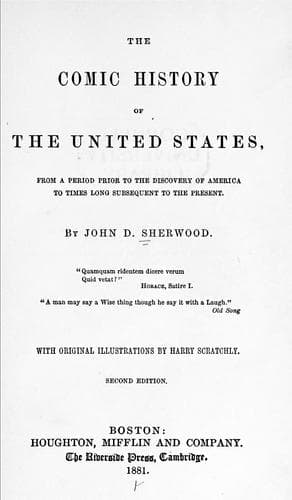
The comic history of the United States, from a period prior to the discovery of America to times long subsequent to the presentSherwood, John D.
History
The comic history of the United States, from a period prior to the discovery of America to times long subsequent to the present
Sherwood, John D.
United States -- History -- Humor
At the opening of the crocuses, in the spring of 1778, Lord Howe and his
brother, the Admiral, were in the Quaker City, a city which, though
mainly made up of the disciples of peace, wielded both pen and musket in
favor of war for peace. A French fleet, commanded by Count d’Estaing,
sailed from France to pen up in the Delaware the English brothers with
their fleet and army; but these some Howe getting at once wind of this
intention and into their own sails, contrived to escape to New York.
Part of the British forces took the land route to New York, courageously
braving the dangers incident to New Jersey travelling. A little accident
befell them on the route, June 28th, about eighteen miles south of
Philadelphia, at a small place then called Monmouth, where, colliding
with Washington and the artillery train of which he was conductor, they
lost three hundred men. The American loss was only seventy,—very
trifling for a genuine American collision. It was in this battle that
General Charles Lee became insubordinate, lost his reason, and was cast
on the lee shore of patriotic duty,—a misfortune which, eighty-three
years later, happened to another general of the same name.
The French fleet, finding on its arrival at Philadelphia, that the Howes
had gone to New York, followed suit thitherward; but on reaching Sandy
Hook, it was defeated in its intended action against them by an
injunction raised by the New York bar, and so proceeded to that
fashionable watering-place, Newport. Admiral Howe soon after took a
notion to go to the same place, and, being reinforced by several ships,
set out with his squadron. D’Estaing, intermitting his study of the
“Round Tower,” “The Spouting Rock,” and “The Dumplings,” sailed out like
a generous foe, to meet him half-way. The fleets, long in ogling sight,
and loath to leave each other, were yet kept apart by those adverse
winds and rough seas which sometimes in naval war, as in love, neither
blow nor run smooth, and which, at least in this case,—as sometimes
happens with lovers,—prevented an engagement.
In September, General Clinton, who had superseded Lord Howe, sent out
two marauding expeditions, one to Buzzard’s Bay, which burnt seventy
American ships roosting there on their anchors; the other against Little
Egg Harbor, which took a considerable amount of stores laid there, over
which much British cackling was had.
The massacre at Wyoming by Colonel John Butler and his Indian
allies—only palliated by the plea that, while it cruelly put out of
existence some three hundred settlers, it called into being the
beautiful “Gertrude of Wyoming”—and the barbarities committed by another
band of Tories and savages at Cherry Valley, raised the hair on the head
of many in Europe as well as in America.
Public-domain text, read in full here on John Shaqi.
Reviews
Reviews
No reviews yet
Be the first to share your thoughts on this work.
Elsewhere in the archive
Join the Discussion
Join the discussion
Sign in to leave a comment or review.
Sign InorCreate an account