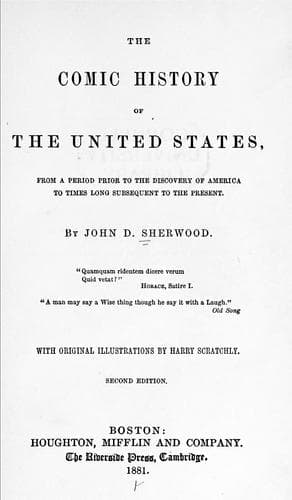
The comic history of the United States, from a period prior to the discovery of America to times long subsequent to the presentSherwood, John D.
History
The comic history of the United States, from a period prior to the discovery of America to times long subsequent to the present
Sherwood, John D.
United States -- History -- Humor
As soon as September began to cool the air and make travelling tolerable
in a warm climate, General Greene, with an American party, and Colonel
Stewart, with an English company, took it into their heads mutually to
visit Eutaw Springs, about fifty miles west of Charleston. The meeting
was unusually lively; in fact, quite an Irish gathering. Like most Irish
fights, too, it was impossible to say, which had the worst of it. Both
sides held a funeral wake over about three hundred killed, and claimed
the fewest graves and victory.
After this affair, the British flock, which had been scattered more or
less over the two Carolinas and Georgia, gathered back and alighted for
a long time on two favorite spots, Charleston and Savannah. Near them
gradually collected ready American hunters and fowlers, fond of foreign
game, vigilant in watching and very desirous of bagging the entire lot.
Meanwhile, Cornwallis had advanced northward through North Carolina into
Virginia, where the young French marquis—more fortunate than the almost
useless French fleets, first under D’Estaing, and afterwards under
Admiral De Ternay—was doing good service. The route of Cornwallis was
nearly along the present track of the Wilmington and Weldon Railroad,
which fortunately for him was not then in existence, to invite him to
use its delaying time-tables and dangerous rails. As it was, he reached
Petersburg in the course of time, and in safety.
A detachment sent to Charlottesville, where the Legislature of Virginia
was in session, seized several of those most unmanageable specimens of
the human race, members of assembly, troublesome enough when let alone,
but as prisoners wholly incapable of definition, exchange, or valuation.
The squad came near burning their fingers by taking the red-haired and
red-vested Jefferson, whose term as Governor had expired only two days
before, but around whose head there yet lingered enough of the aureola
of official dignity to make him worth several cart-loads of assemblymen.
For Cornwallis himself the three military fates—Washington, Rochambeau,
and Lafayette—were securely and steadily spinning lines for his
entanglement. At last they enmeshed him at Yorktown. Nine thousand
Americans and seven thousand Frenchmen held the netting which, gathered
in fold after fold, finally, October 19, 1781, caught the whole
shoal,—Cornwallis, that voracious old pike which had devoured scores of
American armored fish, and 7,000 others. In this splendid haul were
found 235 cannon, 8,000 small arms, and regimental colors enough to
supply all the state-houses for the next sixty-five years.
When Lord George Germain hastened with the disagreeable and accelerating
news to Lord North, the premier raised his hands wildly in the air, and
exclaimed, with an oath too big to fit our Comic History, “It is all
over.”
For the first time, during the last six years, Lord North was right.
Public-domain text, read in full here on John Shaqi.
Reviews
Reviews
No reviews yet
Be the first to share your thoughts on this work.
Elsewhere in the archive
Join the Discussion
Join the discussion
Sign in to leave a comment or review.
Sign InorCreate an account