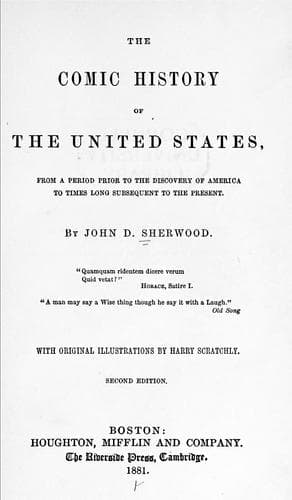
The comic history of the United States, from a period prior to the discovery of America to times long subsequent to the presentSherwood, John D.
History
The comic history of the United States, from a period prior to the discovery of America to times long subsequent to the present
Sherwood, John D.
United States -- History -- Humor
His principal, Benedict Arnold,—who had suffered the canker of excessive
extravagance to eat through his brave and well-shredded military
coat,—escaping from our dangling line into the English straighter ones,
received fifty thousand dollars and a brigadier-general’s commission. He
was subsequently elected by General Contempt into the celebrated order
of Judas Iscariot.
The campaign of 1781 was inaugurated New-Year’s day by a good-natured
and semi-patriotic insurrection among the Pennsylvanian troops stationed
at Morristown, New Jersey; not on account of the Jersey ways, usually
deemed so hostile to foreigners, but by reason of the scant fare,
clothing, and pocket-money to which they were reduced. Marching to
Princeton, they were met by emissaries from General Clinton, with large
offers of bounty-money to enlist for King George; but the noble-minded
troops, spurning these attempts upon their virtue, delivered up these
agents, as spies, to General Wayne. A committee from Congress relieved
the just needs of the insurgents, and offered them rewards for their
patriotic treatment of the spies; but they refused to accept pay for
what, they truly asserted, was but their duty.
With such metal were the new moulds of American life filling up. By such
iron bands was the Revolutionary wheel made strong and irreversible.
The attention of Congress was now seriously and effectively drawn to the
condition of the army,—the crank of the wheel. Robert Morris was
appointed Superintendent of the Treasury; and the treasury—till then a
very celestial affair, undefiled by filthy lucre, and having out-goes in
the place of in-gots—was tolerably supplied by taxation at home and
loans abroad.
Again the scenes of the war lie south of Baltimore. At the Cowpens, in
South Carolina, Colonel Tarleton was caught on the horns of Morgan,
three hundred of his men tossed fatally, and the rest, with their
leader, severely gored and gashed. Cornwallis soon found that the
Southern commander was not a Greenehorn. At Guilford Court-House, the
English leader, with a superior force, met the American general, with
4,500 men, and after a severe grapple, fell back with the air and
conviction of a man disagreeably undeceived. The Americans now seemed to
have received an ally in general success; for in April, May, and June
they retook, one after another, all the forts, outposts, cities, and
military points occupied by Lord Rawdon. On the Catawba, Morgan gave to
Tarleton a little more grape, which sent his lines reeling backwards in
awkward confusion towards the main body.
Public-domain text, read in full here on John Shaqi.
Reviews
Reviews
No reviews yet
Be the first to share your thoughts on this work.
Elsewhere in the archive
Join the Discussion
Join the discussion
Sign in to leave a comment or review.
Sign InorCreate an account