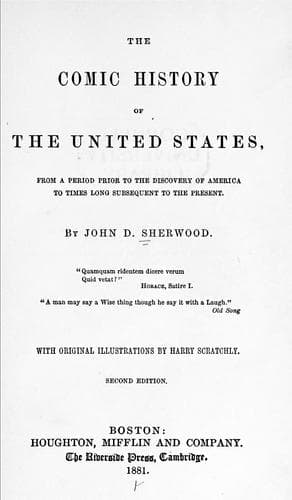
The comic history of the United States, from a period prior to the discovery of America to times long subsequent to the presentSherwood, John D.
History
The comic history of the United States, from a period prior to the discovery of America to times long subsequent to the present
Sherwood, John D.
United States -- History -- Humor
In a word, the States were everything, the Confederation nothing. The
powers of the latter were, like poor pine boards, filled with nots. The
Confederation could not, of itself, levy taxes; it could only cipher up
what each State ought to pay, and then advise it to pay the sum stated.
It could not raise an army; and, amid the extra jealousy against a
military force, it was hardly suffered to figure out the quotas of the
various States which might, if they saw fit, follow the advice, or
might, if they chose, disregard it. Of course the States generally
treated these debiting bills as any customer would a draft upon him,
when accompanied by an intimation that, although payment was desirable
to the writer, he, the correspondent, might pay or not, as and when he
found it convenient. Without trembling as Felix did, they adopted the
Roman governor’s mode of dealing with unpalatable advice,—thoughts and
suggestions of a judgment to come being postponed to a time which,
rainbow-like, never touched them. The Confederation had no power over
exports or imports, or the revenue therefrom; the States sitting along
the sea-shore, keeping each its own straw to suck its private fill from
the large maritime bowl in front of it. It had no authority to punish
treason, as the States considered it no crime to hurt or maltreat the
poor manikin which they had set up.
It could not even collect more postage on letters than was barely
necessary to defray the expenses of carrying the mails. As for the
franking privilege, that curious Congressional levy on the public
treasury, comically supposed to be repaid to the people by heavy
speeches, very uncurrent and untransportable, which require all the
government levers to lift them up to the unwilling hands of their
constituents, this privilege was as yet undiscovered.
There was one prohibition which might, in our time, with great advantage
to the public interests, be even extended; the interdict upon men going
to Congress more than three years out of six. Even the three years might
be profitably prohibited,—an economy of bad laws, bad speeches, bad
manners, and of $1,635,000 annually paid for salaries.
It is noteworthy, however, that among the stark cold negations of the
Confederation act, there were two warm affirmative provisions, one
securing to persons of every color equal rights in all the States, the
other making each man’s conscience the teacher and judge of his
religious belief. These were the two red currents, the arterial blood,
which kept alive the lumpish, footless, armless, and eyeless grub, and
preserved it during the Revolution, and through the caterpillar,
chrysalis condition from 1783 to 1787, until at last, in the latter
year, it burst forth into the glad, beautiful, perfected butterfly, the
Constitution, vital with sustaining power, bright with yellow promises,
and rising joyously into the large air of healthy freedom.
Public-domain text, read in full here on John Shaqi.
Reviews
Reviews
No reviews yet
Be the first to share your thoughts on this work.
Elsewhere in the archive
Join the Discussion
Join the discussion
Sign in to leave a comment or review.
Sign InorCreate an account