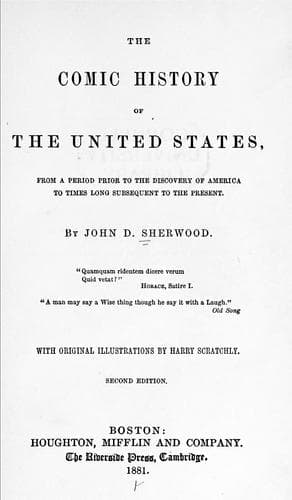
The comic history of the United States, from a period prior to the discovery of America to times long subsequent to the presentSherwood, John D.
History
The comic history of the United States, from a period prior to the discovery of America to times long subsequent to the present
Sherwood, John D.
United States -- History -- Humor
Of these latter stationary or retrograde and always negative qualities,
the Confederation largely partook. The committee, appointed by Congress,
June 11, 1776, to draft a plan for governing the thirteen Colonies,
shared in the feeling, indulged by the people at large, of apprehension
as to the natural driftage of central power athwart popular rights.
They, like their constituents, were very subject, to that political
fever and ague, a shivering, chilly dread that an American parliament
might grasp and abuse the power of taxation as the English congress had
done, and a heated, burning fever whenever the possibility of
legislation in matters of religious faith was started in any vein.
Denying the power of King George, George Grenville, or any other George,
to put his hand in their pockets, they thought it logical—and it was the
natural logic of distrust—to refuse permission even to their own agents,
although frequently elected and called to account by themselves, to
agree upon any plan of mutual contribution for the common good. Smarting
under wrongs inflicted in the name of government, our confederated
progenitors were never able to gain political faith and strength enough
to crawl out from under the shady side of authority around to its sunny,
cheery, beneficent face.
The needs for a Union were yet unfelt. All the thirteen Colonies held
slaves, all sloped to the Atlantic, and all, except Pennsylvania,
touched the sea. Their substantial agreements created as yet no wants;
their broad areas made them independent; their slight diversities were
not so strong as to require the firm hand of central power to bind them
within a well-hooped circle, within which aggressive rights might be so
restrained as not to become antagonistically hostile, and which might
yet continue so free that their forces might work together and onward in
large and enlarging action.
The Committee sat for sixteen months; and in November, 1777, the
lumpish, inert grub of Confederation saw the light. A poor, weak grub it
was, without developed legs to go on, without eyes to see with, filmed
over with a gelatinous, swathing membrane, squirming in feeble
inanition, and feeling as cold as a tax-bill, or the shake of a
cashier’s hand with a doubtful bank customer on discount day.
The scheme of Confederation was the child of Doubt, put out to the nurse
of Jealousy.
It was watched to death by the members of the State family, each taking
its turn, and each well provided with the cold-gruel theory, that what
the child cried for was not good for it, and that what it really and
always wanted was a sound course of starvation. And so starvation it
got, with an occasional blue-pill administered by those little teasing
children, Maryland, Rhode Island, and Connecticut, whose jealous
pretensions were of course inversely to their size. No wonder that the
brat grew pale.
Public-domain text, read in full here on John Shaqi.
Reviews
Reviews
No reviews yet
Be the first to share your thoughts on this work.
Elsewhere in the archive
Join the Discussion
Join the discussion
Sign in to leave a comment or review.
Sign InorCreate an account