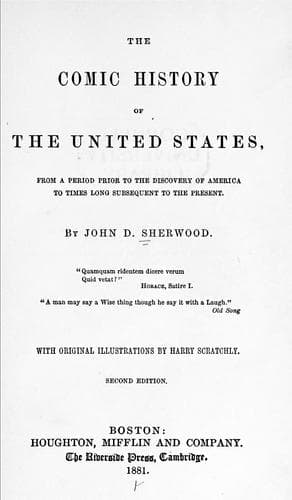
The comic history of the United States, from a period prior to the discovery of America to times long subsequent to the presentSherwood, John D.
History
The comic history of the United States, from a period prior to the discovery of America to times long subsequent to the present
Sherwood, John D.
United States -- History -- Humor
On the other hand, if Mr. D. Webster or Mr. H. Clay desires a thorough
suit for the central Federal figure of Uncle Samuel, he is shown
directly to the sections where he can procure quantities of them; hats
to cover banking brains; coats and vests to put over the inner works, to
aid digestion and promote internal improvement; pants, hosiery, and
boots to keep up our Uncle’s advancing strides over mountains, plains,
and rivers. Such customers are, of course, walked up directly to section
eight, and there are shown in a large box ample and well-made garments
of the desired description. On the top of this box the fabricators have
put this explanation: “To make all laws which shall be necessary and
proper for carrying into execution the foregoing powers.”
It was supposed by many of the original members of the firm, who got up
this grand Constitutional bazaar, that Uncle Sam’s concern had the
exclusive right to make those bright, popular buttons called “coin,” or
“money”; but it was discovered in a very short time that there was an
elastic provision in the articles of copartnership, which allowed the
individual members of the firm to manufacture, each on his own account,
these shining disks, and even to invent and put forth for sale paper
substitutes, which at length became so much in vogue as to drive the
metallic article, at times, wholly out of the market. Paper collars have
not had a livelier run, nor damper shrinkages than these.
Statements are often put forth by people sitting on benches and having a
grave, sometimes a grave-clothes air, doubting the right of the Federal
store to stamp exclusively and to put out for its own particular profit,
a variety of things, kept there in well-locked sections; it being
claimed that the composing members have a concurrent power to make,
stamp, and vend the same goods. On some of these points the discussion
is still going on, and as the partners are a jealous, sharp set, it is
not likely soon to terminate.
Much trouble has arisen in regard to a large number of bills of credit
which have been issued by, and are still outstanding against, the large
Federal concern. Some have questioned their power to manufacture this
kind of paper and make it equal to hard coin. Others have doubted the
legality of the step which the firm took in making this paper good for
certain purposes, and not receivable as pay for certain kinds of debts
due to the house, arguing that if coin was better than paper, then the
paper could not justly be made an equivalent; and if no better, then
that paper ought in all cases to be received as well by the firm as by
others. After much argument before them, however, that popular court,
the ballot, gave a verdict against those who so reasoned, and rendered a
decree that, if there were no other good reasons, the arguments _pro
interesse suo_ and _ad necessitatem_, especially when impelled by the
motor of war, were too convincing to be set aside, and so legalized the
discrimination.
Public-domain text, read in full here on John Shaqi.
Reviews
Reviews
No reviews yet
Be the first to share your thoughts on this work.
Elsewhere in the archive
Join the Discussion
Join the discussion
Sign in to leave a comment or review.
Sign InorCreate an account