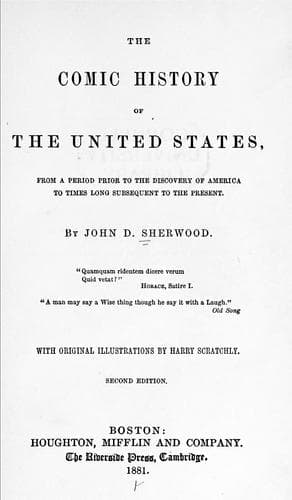
The comic history of the United States, from a period prior to the discovery of America to times long subsequent to the presentSherwood, John D.
History
The comic history of the United States, from a period prior to the discovery of America to times long subsequent to the present
Sherwood, John D.
United States -- History -- Humor
But what a treat it must have been to hear Patrick Henry speak. The
small dishonesties of rhetoric he scorned. To its greatest
opportunities, however, he strode with a master’s step and might. His
long, sallow features then glowed, the stern lines melted into an
illuminating intellectual beauty, his crooked figure, a moment before
like a telescope placed on end and sliding by sections into itself, then
stretched out and up into manliest exaltation, and erect, grandiose
dignity. His keen words, like the battle-axe of the Douglas, cleaved the
subject from head to chine. His large natural thoughts rushed up the
summits of argument, as the free winds sweep the hills, without labor or
effort, and shook all brains, wise or unwise, dull or quick, cultured or
untutored, bending their tops before his resistless march, and shaking
all their obstinate roots by his relentless grasp. No grander storm of
logic, invective, irony, wit, humor, sharp demonstration, soul-rousing
appeal, or tender pathos ever passed over an audience and stirred them
from the deep depths of their nature than that which he awoke. No class
interests, like those of the Virginia parsons for their tobacco tithes,
no selfish isolations, like the petty claims of neighborhood squires, no
encroachments on popular rights, like the Stamp Act or tea duties, could
withstand the noble sweep of his eloquence. The tribune of the people,
he was regarded, ere he had reached his thirty-fifth year, as without
exception the greatest orator in America, if not in the world.
On the opposite page is the photograph of a dear visitor to our family,
GENERAL LAFAYETTE. We never cared to inquire whether he was a relation
or not. He was just as good to us as an own brother. He first came to
see us when we were poor and needed friends. He had great difficulty in
reaching us, as his own government gave orders to stop him. His young
bride, equally noble in her nature, encouraged his coming. He was
obliged to escape from France into Spain, and in a Spanish port to take
passage in a Spanish ship, the only cargo of any value, except that made
up of Columbus and his one hundred and twenty men from Palos in 1492,
that ever came to us from the land of the Cid. The spirited young
marquis remained with us from 1777 to 1781, fighting among our bravest,
suffering privations with the most patriotic, confided in and beloved by
Washington and the best of the Revolution. He made us two visits after
the war, once in 1784, and the second time just forty years later, upon
a special invitation of the nation. Proud and glad were we all to see
him. The most wonderful part of the story is, that, after enduring
vigorous hand-shaking through each of our then twenty-four States, and
kissing all the children from two years old and upwards, he survived the
job ten years.
Public-domain text, read in full here on John Shaqi.
Reviews
Reviews
No reviews yet
Be the first to share your thoughts on this work.
Elsewhere in the archive
Join the Discussion
Join the discussion
Sign in to leave a comment or review.
Sign InorCreate an account