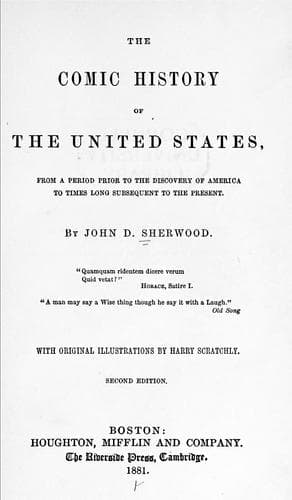
The comic history of the United States, from a period prior to the discovery of America to times long subsequent to the presentSherwood, John D.
History
The comic history of the United States, from a period prior to the discovery of America to times long subsequent to the present
Sherwood, John D.
United States -- History -- Humor
Peace commissioners, however, settled the difficulties, as old ladies do
tea, by a long chat around a covered table. Bonaparte, who had made a
flying military trip to Egypt, had got the Pyramids to look down on him
from their stony, century-crusted tops, while he slaughtered the
Mamelukes at their feet, had pushed across the desert with the _mirage_
of empire ever rising upon his unslaked sight, had made a disagreeable
tour of the Holy Land, and had attempted twenty-three times in vain to
take St. Jean D’Acre, came back to Paris to be made First Consul in
December, 1799,—a Roman office, which he filled like a Roman, by
subjugating all Europe by arms and insolence. The gristle of the
Corsican had at last stiffened into the bone of a ruler of a large,
consolidated empire; and the concentration of power in his hands enabled
him to concede to the justice of America what the shifting authority of
constituted assemblies, conventions, legislative assemblies, and
directories were too weak to dare. Bonaparte met the American
commissioners around the round table, himself as round in power as it in
shape, and in September, 1800, gave his autograph to a treaty of peace
which shielded American independence of action from the insults of the
envoys of a nation hitherto friendly,—a nation which had in a timely and
efficient way, mainly to help itself against an old rival, helped us,
but which, for the preceding ten years, had claimed, and offensively
insisted in return, not from our gratitude, but as a right, that we
should give our assistance to their ever-shifting schemes, with many of
which we had no sympathy, and at a time when to furnish aid was almost
to ruin our young strength.
While the Frenchman was thus bestriding Europe, putting England to her
straits, and in fact even to such despair as to find relief in the Pitt,
our American Colossus fell before the only foe which was ever permitted
to be his conqueror.
Washington died December 14, 1799.
The year following the seat of government was removed to the District of
Columbia, where, by frequent patching since, it has been made to stand
much wear and tear. The city named after Washington is still the
greatest atlas in the United States, its large geography requiring the
most patient study to find out what one is looking for. Many die without
accomplishing it, some by it. The wheel-shaped city has rotated off from
its periphery so many different officials, that, although like a
velocipede it is very hard riding, it cannot well be stopped without
considerable injury to its Federal rider.
Public-domain text, read in full here on John Shaqi.
Reviews
Reviews
No reviews yet
Be the first to share your thoughts on this work.
Elsewhere in the archive
Join the Discussion
Join the discussion
Sign in to leave a comment or review.
Sign InorCreate an account