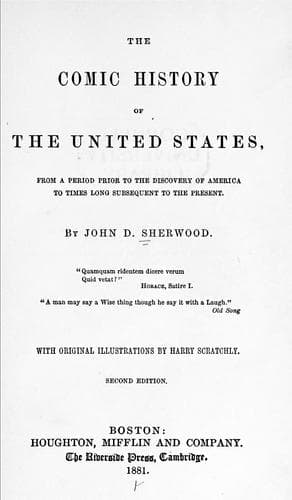
The comic history of the United States, from a period prior to the discovery of America to times long subsequent to the presentSherwood, John D.
History
The comic history of the United States, from a period prior to the discovery of America to times long subsequent to the present
Sherwood, John D.
United States -- History -- Humor
Few Removals by Mr. Jefferson from the Ungilt, Official Chairs.—Mr.
Smith gets into the Navy.—Who started long Messages to Congress; and
the Difficulty of finding an End to them.—War with Tripoli; and the
Complexion with which the Bey ended it.—Decatur and his Mediterranean
Travels.—Ohio in 1802.—The early Danger it ran of being all cut up
into City Lots.—How the Exodus of its Population was the Genesis of
its Growth.—Of Westering Caravans.—Bonaparte sells Louisiana, and what
a Sell it was.—How we were saved an extra Volume of Supreme Court
Decisions.—The Murder of Alexander Hamilton.—A Ghost-Story about Aaron
Burr.—The public Estimate of his Character unchanged by Biographical
varnishing.—A South Carolina Conceit.—The Play of Lear in
Tripoli.—Peculiar Mussulman Habits; the Author of Don
Quixote.—Michigan escapes the Cuppings of Eastern States.—Her
lymphatic Temperament.—Lake Michigan as a Breakwater against
Chicago.—Burr tried for Treason, “not proven” guilty, and
surrendered—to himself.—Of Bonaparte and other Usurpers.—The Oldest
dislike the Youngest.—History of the Attempts of George III. and
Bonaparte to blockade without Ships.—Once a Bull always a Bull.—Search
of American Ships for Seamen.—The Unwisdom of Half-Apologies.—The
American Embargo and its Popularity with Unmarried Girls.
The advent of the first Democratic brave to the dispensing patronage and
to the right of taking official scalps, was not followed by a general
emptying of official chairs and the massacre of official enemies. The
thirty-five ballotings in the House of Representatives between Mr.
Jefferson and Aaron Burr made men anxious, not hungry and thirsty. The
fair-minded Madison was appointed to the State Department; Albert
Gallatin, the golden-mouthed, to the Treasury; and Robert, not John
Smith, to the Navy. Few changes were made in the ungilt places; although
the innocent public of that day were not a little excited, at the bare
suspicion that a few dozen Federalists were removed for their political
opinions. The guilt of differing politically from the administration was
not considered by the President so flagrant as to be adequately punished
only by exile from office.
Upon Mr. Jefferson must, however, be laid the crime of beginning the
practice of sending to Congress messages in writing,—a beginning which,
like the messages themselves, seems to have no end. Since the flood
human life is far too short for these Presidential essays, even without
the accompanying documents.
Public-domain text, read in full here on John Shaqi.
Reviews
Reviews
No reviews yet
Be the first to share your thoughts on this work.
Elsewhere in the archive
Join the Discussion
Join the discussion
Sign in to leave a comment or review.
Sign InorCreate an account