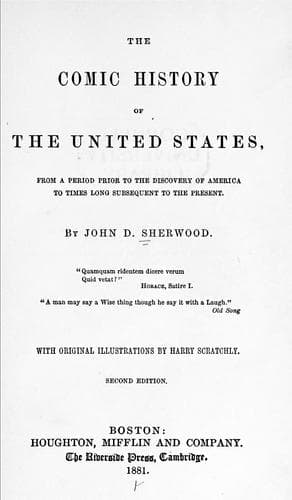
The comic history of the United States, from a period prior to the discovery of America to times long subsequent to the presentSherwood, John D.
History
The comic history of the United States, from a period prior to the discovery of America to times long subsequent to the present
Sherwood, John D.
United States -- History -- Humor
A war with that dusky corsair, the Bey of Tripoli, clouded the very
commencement of the new administration, breaking finally, after lasting
three years, into a heavy shower, February 9, 1804, from the cannonading
guns of young Decatur’s ship, the “Intrepid”,—a shower followed by
blue-skied peace. Commodore Preble, who with his fleet had been dealing
with Morocco, assisted in tanning, by some of Bellona’s
bleaching-powders, the sable-peltried Tripolitan. The result was that
the Bey turned to another complexion in his treatment of Christian
captives.
In 1802 Ohio doffed the pantalets and appeared around the Union board as
a full-grown State. Some of her settlements had grown so fast, and so
threatened to absorb the land into building-lots, that it was feared for
a time that the surface would be insufficient for farming purposes. The
exodus of population farther westward, however, relieved the anxieties
of its genesis, and marked the first chapter of its growth. The bivouac
that had encamped on her grandly rolling rivers began soon to join the
westering caravan which pitched their tents across the Mississippi
against the sunsettings. A Hoosier who borrows money at two per cent a
month to buy land with may be trusted to pay it back in a short time.
Two to nothing that he will add from his generosity a bonus with the
return of the loan.
Bonaparte, now Consul for life, and in sore need of money, sold to us,
for $15,000,000, that tract of country stretching undefinedly towards
the Pacific, and called Louisiana. Some of the wits of that day raised
the question whether the purchase lawfully included alligators of such
length that they stretched over the boundary lines. Neither this great
question, nor the secondary one of the right of our government to buy
foreign territory, was mooted in the Supreme Court, and thus we were
spared an extra volume of majority essays and longer dissenting
opinions. The foreign pill was too sugar-coated to cause any wry faces.
It was a very big sell—for France.
In July, 1804, Aaron Burr, Vice-President, murdered Alexander Hamilton
at Hoboken. Some biographers have attempted, since the death of the
future exile and fugitive from justice, to lighten the heavy burden
which he carried for thirty-three years afterwards, but in vain. The
public rarely reverses its first verdict. They can seldom be made to
believe that its first look at the piece was on the wrong side, and no
new napping or glossing will convince it that the other is the right
side.
The Presidency took such a fancy to Mr. Jefferson that, at his
re-election, in 1804, he received 162 out of 176 votes cast; C. C.
Pinckney, Esquire, of South Carolina getting the other 14. South
Carolina then had the pleasant little conceit of voting for herself,—a
harmless pastime that kept up her peculiar idea of resistance to Federal
subjugation, and made a variety for the tellers in counting the contents
of the electoral urn.
Public-domain text, read in full here on John Shaqi.
Reviews
Reviews
No reviews yet
Be the first to share your thoughts on this work.
Elsewhere in the archive
Join the Discussion
Join the discussion
Sign in to leave a comment or review.
Sign InorCreate an account