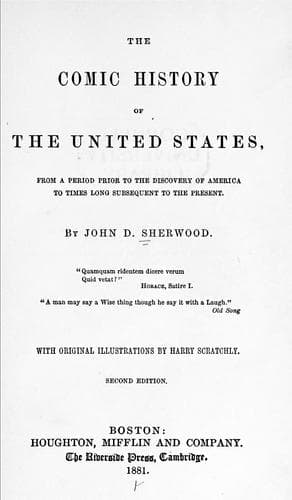
The comic history of the United States, from a period prior to the discovery of America to times long subsequent to the presentSherwood, John D.
History
The comic history of the United States, from a period prior to the discovery of America to times long subsequent to the present
Sherwood, John D.
United States -- History -- Humor
In 1819 Florida was bought from Spain for $5,000,000, and delivered to
us in 1821. We got with it more than our bargain,—a lot of very sharp
Indian tomahawks. To blunt them soon cost $30,000,000. The Dry Tortugas
were thrown in. So were the Florida Keys. So were the alligators.
Fortunately the night dews were left to prevent the peninsula from
cracking off. Our Union is for better or worse. We took Florida in the
era of good-will; we keep it for nothing. Among the crockery in the
family cupboard an occasional cup comes with a cracked handle or broken
edge. Having little to do at home, our statesmen turned their attention
to Venezuela and New Granada, then fighting under Bolivar for their
independence of Spain. Bravely they spoke up for the under cur in the
fight; but more courageous still, the President, in his annual message
for 1823, declared, as a principle, in spite of the crowds of colonists
to our own ports, that no European nation had any right to colonize any
territory on the Western continent,—a Monroe doctrine which, like the
laws, is very loud-spoken in peace, but very silent in war.
CHAPTER IX.
TROUBLES BUBBLE; OR, THE SORROWS OF JOHN QUINCY ADAMS.
1825–1829.
Parallel between Sidney Smith’s Old Razor and J. Q. Adams’s Term.—How
several Gentlemen, touched by Age, reached in Vain after Honors too
high.—Who they were; and what Acid Grapes the House of Representatives
snatched from them.—Pamphleteering and Privateering.—An Italian
Saying.—Description of a Good Statesman spoiled in the Mould of a
Politician.—An Illustrative Anecdote.—Partisan Scales weighing Public
Interests.—The Weights.—The Depravity of Political Blunders.—History
vs. Party Judgments.
Sidney Smith once said “that he was like an old razor,—always in hot
water or in a scrape.” The term of the second Adams had similar
agreeable occupation. The water was very hot when this political blade
was first thrust into it. Mr. Monroe’s double term was so quiet, dozy,
and apparently so long, that several gentlemen, outside of Virginia,
felt that they were growing old, and might, unless they improved the
chance, easily slip out of it. Besides Mr. Adams, there were, as
candidates, General Andrew Jackson of Tennessee, William H. Crawford of
Georgia, and Henry Clay of Kentucky; among whom General Jackson received
the highest popular vote, and Mr. Adams the next. In the House of
Representatives, the ballot taken by States gave Mr. Adams 13, General
Jackson 7, and Mr. Crawford 4 votes. Each of these was a dragon’s tooth,
which was carefully sown, and produced rank growths of sulphur-colored
partisans, whose drifting seeds grew into poisonous crops all along the
public roads. Pamphleteering became privateering on private reputation.
Industrious falsehoods supplied for many years the warp of history.
“_Si non è vero è ben trovato_” was the maxim of ingenious and
disingenuous fraud.
Public-domain text, read in full here on John Shaqi.
Reviews
Reviews
No reviews yet
Be the first to share your thoughts on this work.
Elsewhere in the archive
Join the Discussion
Join the discussion
Sign in to leave a comment or review.
Sign InorCreate an account