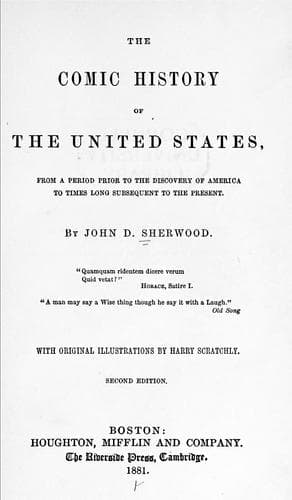
The comic history of the United States, from a period prior to the discovery of America to times long subsequent to the presentSherwood, John D.
History
The comic history of the United States, from a period prior to the discovery of America to times long subsequent to the present
Sherwood, John D.
United States -- History -- Humor
Naturalists tell us that certain animals, domesticated from a wild
state, retain some primeval habits so tenaciously as never to shed them;
that these animals, for example, never lie down on their new and softer
beds without turning around and beating about as in their forest lairs.
So military men, tamed down from the independence of camp into the
regulated routine of civil life, never lose their unrest in attempting
to adjust themselves to their new condition. General Jackson carried the
defiant bravery of his campaigns against the Indians into the white den
at Washington. He disdained to cover the prehensile claws of new
measures with the velvet sheath of official prudence.
Over the eyes of schemes or institutions which he designed to scratch
out he cast no glamour.
During his eight years of civil campaigning, he stormed several forts
that had become mossed by age through preceding administrations. His
first care was to live off the enemy, the Adamites, whose Federal
offices he took as forage for his own troops of friends; an example from
the military code which every successor, civil or uncivil, has
unfortunately hastened to follow. Lord Palmerston once declared “that
Mr. Gladstone had not a command of language, but that language commanded
him.” So it has resulted from this tough, hickory precedent, that the
offices now command the government.
This campaign over, his next exploit was to quell an insurrection among
the household troops led by Vice-President Calhoun, Mr. Ingham,
Secretary of the Treasury, Mr. Branch, Secretary of the Navy, and Mr.
Berrien, Attorney-General. These officers were soon cashiered and their
places filled by Mr. McLane, Mr. Woodbury, and Mr. Taney. The lily-white
arm of a lady, whose social exclusion from the Calhoun set the vigorous
old warrior resented, moved the iron sinews of the hickory club which
cleaned out the Secretarys’ stables.
The General next moved on the United States Bank, up whose slopes,
although jagged with ores and hoary with legislative fortifications, he
rushed, carrying them at all points with a _coup de main_.
His first term, however, was made illustrious, not so much by these
destructions as by the first appearance of Chicago. This was in 1830. At
this time, fortunately, the population of the United States had reached
12,866,020, and were thus saved from being overtaken and immediately
annexed to that rapid and rapidly pushing place. This Northern cosmical
event attracted less attention, however, because the public mind was at
last and about this time fixed upon the State of Mr. C. C. Pinckney,
which, under the guidance of Mr. Calhoun, threatened to exclude the
Federal hickory government from its plantation, unless the Tariff Act
was repealed.
Public-domain text, read in full here on John Shaqi.
Reviews
Reviews
No reviews yet
Be the first to share your thoughts on this work.
Elsewhere in the archive
Join the Discussion
Join the discussion
Sign in to leave a comment or review.
Sign InorCreate an account