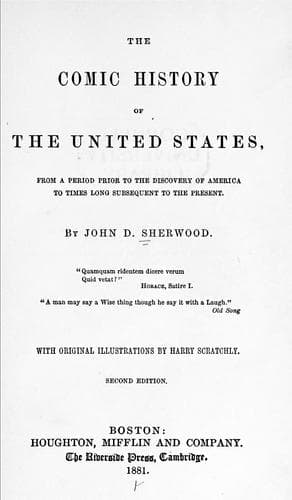
The comic history of the United States, from a period prior to the discovery of America to times long subsequent to the presentSherwood, John D.
History
The comic history of the United States, from a period prior to the discovery of America to times long subsequent to the present
Sherwood, John D.
United States -- History -- Humor
The old military chief issued a public proclamation, asserting his
determination to execute the laws over South Carolina, and private
threats to raise the main nullifier to a lofty post under the
government. Indeed, he promised to some of his close personal friends,
with ejaculations truly Jacksonian, to put him between two posts for the
rest of his life.
This was the first sprouting of the carefully engrafted scion of slavery
upon the stock of State rights.
Again, the Kentucky compromiser was ready with a harmonizing remedy,
which scaled the tariff rates for the next ten years, and then planed
them all down to the horizontal level of twenty per cent. South
Carolina, lying, like Achilles, near her ships, professed to be
appeased. Mr. Calhoun was saved his hempen elevation.
The year following, 1833, Horace Greeley started in New York “The
Morning Post,” the first daily paper ever projected, which lived only
three weeks, and wondered why it ever lived at all;
“Whose all of life, a morning ray,
Blushed into dawn then passed away.”
The Sacs, Foxes, and Winnebagoes, with tomahawks in their talons, and
led by Black Hawk, swooped in hovering circles around the white chickens
of Illinois; but were brought down by those practised marksmen, Generals
Scott and Atkinson. The old Hawk was captured and shown through the
United States in his drooping feathers. In Georgia, on the other hand,
the whites were the aggressors, seeking to push the Creeks and Cherokees
from their coveted possessions. The Indians fled to the Supreme Court of
the United States, which bade Georgia restore the poor Naboths to their
vineyards. The Ahab sovereignty of that State resisted. The President
refused to interfere. The nullification by Georgia of a decree of the
Supreme Court, restoring Indians to their rights, was, in the eyes of
the old Indian fighter, quite a different matter from the nullification
by Calhoun-led South Carolina of an act of Congress. So far from being a
hair-splitter, the General could not even see whole shocks, if the poll
was long, straight, and black. In 1835 arose another Seminole war in
Florida, caused by an attempt on the part of the government to remove
that powerful tribe, under a mock treaty, somewhere, nowhere, anywhere,
so that it was west of the Mississippi, and away from present cupidity.
On the public debt, now dwarfed to $291,089, this war was like an April
shower. Florida had the satisfaction, for the third time in sixteen
years, of increasing the obligations of the United States for, if not
to, her. In this peninsular campaign, we obtained three celebrities to
knob the flat surface of our history,—Generals Zachariah Taylor, Jessup,
and Gaines,—gains compared with which the loss of life and lucre are not
to be mentioned, except to stiffen our virtues by reproaching their
suggestion.
Public-domain text, read in full here on John Shaqi.
Reviews
Reviews
No reviews yet
Be the first to share your thoughts on this work.
Elsewhere in the archive
Join the Discussion
Join the discussion
Sign in to leave a comment or review.
Sign InorCreate an account