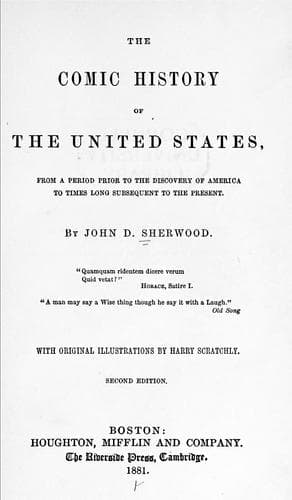
The comic history of the United States, from a period prior to the discovery of America to times long subsequent to the presentSherwood, John D.
History
The comic history of the United States, from a period prior to the discovery of America to times long subsequent to the present
Sherwood, John D.
United States -- History -- Humor
At the time General Harrison was called from the clerkship of the County
Court of Hamilton County, Ohio, to preside at the People’s High Assizes
at Washington, he lived at North Bend, a very different crook from that
of his predecessor. He was sixty-eight years of age, and in feeble
health; yet so seldom do people die in desirable offices, that any
life-insurance company would have taken his life in a policy at the
lowest premium.
April 4, 1841, however, he died. Of course John Tyler, the
Vice-President, did not. To the subsequent regret of his party he lived
on—a plane of his own, quite apart from the platform upon which he was
placed by them, and bisected by a Virginia ecliptic so oblique that it
rarely touched anything or anybody. Mr. Clay and the Whigs tried hard
and long to shape a bank bill to his amphibious tastes; but as they
could not find a body, neck, or feet to suit the bill, they abandoned
the study of natural history as illustrated by Mr. Tyler. A bank—some
bank—he seemed desirous to have; because he entertained a profound
conviction that a bank was a good place to put a counter in. Like the
gentleman who possessed a first-rate flint, and wished a gunsmith just
to fit a good breech, lock, stock, and barrel to it, the acting
President seemed anxious, in his interviews with the Congressional
banksmiths, to have them fit a good bank, vaults, specie, and
circulation, to his admirable counter.
As Cuvier objected to the definition of a crab given by the French
Academy, namely, “that it was a small red fish which walks backwards,”
as “wanting three things to make it correct: first, that the crab was
not a fish; second, that it was not red; and third, that it did not walk
backwards”: so the leaders of the party which elected him found equal
fault with Mr. Tyler as defining in his own person the name of Whig on
three grounds: first, that he was not a Whig in principle; second, nor
in theory; third, nor in practice.
The original Cabinet members all resigned, except Mr. Webster, Secretary
of State, who remained to complete in July, 1842, with Lord Ashburton, a
treaty to disentangle our northeastern boundary lines and fish lines
from the hard knots into which they were running.
A Bankrupt Act was thrown out by Congress in 1841, as planks for traders
shipwrecked by the tidal waves which followed the earthquake of 1837;
but the principal benefit of the act resulted in throwing the stranded
fortunes to the official wreckers, called assignees in bankruptcy, who
secured most of the stuff cast upon the shore. In two years this
barbarous wrecking business was stopped by the repeal of the law.
Public-domain text, read in full here on John Shaqi.
Reviews
Reviews
No reviews yet
Be the first to share your thoughts on this work.
Elsewhere in the archive
Join the Discussion
Join the discussion
Sign in to leave a comment or review.
Sign InorCreate an account