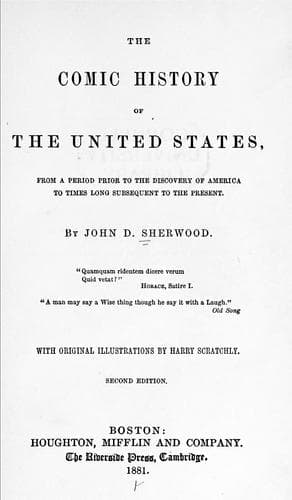
The comic history of the United States, from a period prior to the discovery of America to times long subsequent to the presentSherwood, John D.
History
The comic history of the United States, from a period prior to the discovery of America to times long subsequent to the present
Sherwood, John D.
United States -- History -- Humor
A financial earthquake broke through the commercial crust the first year
of Mr. Van Buren’s term, shattering most of the crockery in the great
cities, and sputtering red menaces of ruin through almost every village
and country store. In New York alone merchants toppled down amid heaps
of indebtedness piled up to $100,000,000,—a respectable pile then, now
scarcely worth failing for. To help up the departing credit, the
President recommended the sub-treasury scheme, or separate chests for
guarding the public moneys. Of course this expedient, like all financial
measures, was Dutch to the people generally, who became more hopelessly
anarchical by the interminably long messages, which aggravated their
want of ideas, and somehow fretfully tangled their losing tempers and
accounts.
A few defalcations among public officers chafed the popular mind to an
illogical but natural irritation. They looked upon the guard-houses of
the national moneys, like an old man’s residence, insecure from his
broken gait and few locks. The dark phantom of slavery again flitted
over the land, its dusky shadow disturbing the vision of commercial and
political traders. The President had, in his boresome in-augur-al,
promised to his Southern supporters, in advance of Congressional action,
to veto any bill forbidding slavery in the District of Columbia.
Petitions against slavery were laid under the table, while speeches in
its favor were extremely fashionable. Mails at the South were opened for
the discovery of antislavery papers. Politicians perfumed their
handkerchiefs with _extraits de l’Afrique_, and Northern merchants on
the seaboard sold to the South their principles and goods at a profit.
Still the great trader in the White House kept losing his capital. The
new war with the Seminoles created bad debts. A proposition for a
standing army mined his credit. The sub-treasury scheme drained specie
from the people into Federal pools. To Lindenwald he retired, enriched
by experience, but with his political ballot-paper at a heavy discount.
CHAPTER XII.
THE HARRISON-TYLER TROUPE; HOW IT PLAYED.
1841–1845.
General Harrison’s Death and Life-Insurance Companies.—Whig Bank-Bills
with no Tyler Bodies to suit them.—A Good Flint which required a
first-rate Gun, Stock, Breech, and Barrel, to suit it.—Definition of
Crabs, etc.—The Ashburton Treaty.—The Bankrupt Act, and whom it
helped.—Misfortunes and Fortunes.—Mr. Calhoun’s Texas
Trick.—Diplomatic Magic-Lanterns exposed.—Roman-like Garments with
Carthaginian Spots.—Florida our Stocking Heel; how darned.—Yarns about
it.—Iron Railings as State Corsets.—How the Florida Keys might be
usefully employed.
Public-domain text, read in full here on John Shaqi.
Reviews
Reviews
No reviews yet
Be the first to share your thoughts on this work.
Elsewhere in the archive
Join the Discussion
Join the discussion
Sign in to leave a comment or review.
Sign InorCreate an account