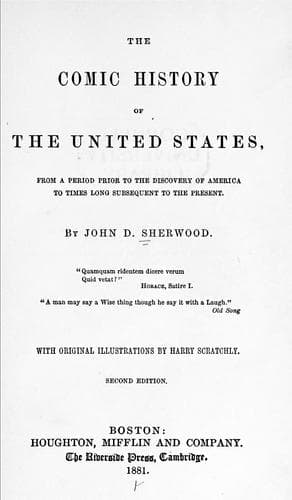
The comic history of the United States, from a period prior to the discovery of America to times long subsequent to the presentSherwood, John D.
History
The comic history of the United States, from a period prior to the discovery of America to times long subsequent to the present
Sherwood, John D.
United States -- History -- Humor
The yellow-fever broke out, soon after the treaty of Guadaloupe Hidalgo,
in our new Californian possession, carrying off people, not thence, but
thither. By the side of palace hotels, now gleaming along golden bays;
solid warehouses, through whose opened doors show the well-stored
sheaves of Continental harvests; settled industries that spike the land
with stacks, vineyards, mills, and spired villages; palace cars which in
a week have blazoned their luxurious splendors through solitudes
threaded only a few years ago by the dangerous blazed track; and giant
steamers wading the Pacific Sea, and carrying to the Mongolian empires
of the Orient a staggering back-load of American products,—by the side
of these actual marvels, even a score of years has made the contrasted
early life of the gold adventurer, gambling in revolver-furnished tents,
dangerous night brawls, and rude visits of vigilance committees, a theme
for romance and its twin ally, history. It had taken nearly three
centuries since Sir Thomas Drake proclaimed California the ward of
Elizabeth, for the North American boy to acquire sufficient courage to
touch her virgin lips, and claim her in happy wedlock.
Our New Mexico brought immediate and national disturbance. Slavery there
was considered objectionable by many; and as soon as Territories were
proposed to be carved out of those wide limits, the Wilmot proviso, to
exclude slavery from it, arose at the expected Calhoun feast like
Banquo’s ghost, and, disturbing the revel, followed with reproachful
look almost every American statesman. It strode into the Democratic
Convention at Baltimore, which nominated Lewis Cass, and sat alongside
of the shivering president and secretaries. It stalked into the Whig
assemblage at Philadelphia, which took the young man for its candidate,
and troubled its peace. Finally, it flitted to Buffalo, and made its
appearance at a mixed gathering which presented Martin Van Buren,—now
the political friend of the ghost,—with just the ghost’s chance for the
Presidency.
And so the ball and polka party turned out very much as other balls.
Those who had expected a great deal from it did not enjoy it much; while
those who had no hand in getting it up had a good time, ate the most
supper, had the least headache the next morning, and often spoke of it
afterwards with pleasurable recollections. Among the former were Mr.
Calhoun, Mr. Polk, and the floor committee; among the latter the modest
young man, now sixty-five years of age, John C. Fremont, several people
who did not part their hair in the middle, and a growing set who were
friends of those who could not divide their crinkled hair as yet either
way or any way.
CHAPTER XIV.
THE NINETEENTH CENTURY ON THE AMERICAN HALF-SHELL.
Public-domain text, read in full here on John Shaqi.
Reviews
Reviews
No reviews yet
Be the first to share your thoughts on this work.
Elsewhere in the archive
Join the Discussion
Join the discussion
Sign in to leave a comment or review.
Sign InorCreate an account