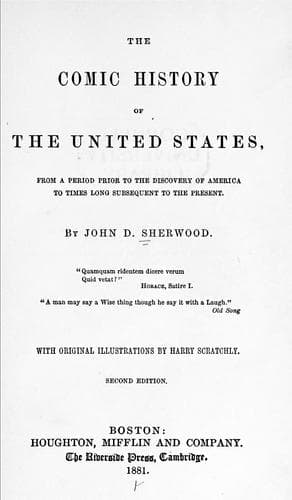
The comic history of the United States, from a period prior to the discovery of America to times long subsequent to the presentSherwood, John D.
History
The comic history of the United States, from a period prior to the discovery of America to times long subsequent to the present
Sherwood, John D.
United States -- History -- Humor
Upon the half-shell were served some remarkable mechanical inventions.
Water raised into steam was, in 1806, applied by Fulton to propel the
first steamboat over water; an application never contemplated by the
Constitution, but which, in spite of the many private constitutions
suddenly broken up by it, the appalling increase in American
biographies, and the wreck of matter thrown upon life-insurance
reserves, must be kindly remembered as one of the great benefactions of
genius to humanity. In 1832 Samuel F. B. Morse discovered the mode of
electro-magnetizing thought, and of ticking down words at places where
thoughts were seldom spontaneously produced. The wiry telegraph is daily
bringing to light other incidental discoveries, which show how great
benefits sometimes pendulate with petty remorses. There are developed at
most stations a class of people, formerly unknown, and called
“operators,” who believe that small accidents, in places unrewarded by
the notice of geographers, are national; that the births, deaths, or
marriages of owners of petroleum, fast horses, or other rapid stock,
concern all readers of newspapers; that the time, age, and pedigree of
quadrupeds, kept for jumping long spaces in a short time, and the
weights of bipeds, sent to college to acquire an increase of their
intellectual strength, but who punish instead an ash stick some four
hours a day, by sweeping with it some frog-pond in the vicinity, are
vital statistics; and that the election of constables, supervisors,
aldermen, mayors, and members of Congress are matters which every
intelligent patriot, instead of banishing from all recollection as
speedily as possible, desires to have forced upon his journalistic
readings. If Morse started, re-morse has often followed after, the
telegraph.
In 1833, one Hussey, from Cincinnati, improving upon hints glinting out
through agricultural books and poems from the time of the Romans,
perfected somewhat a mower and reaper, which, as since bettered by
Manny, Ketchum, and McCormick, has made such quick work with our meadows
and grain-fields, as to break up all the delicious reveries into which
picturesque men in them, and sentimentalists over books representing
them, formerly indulged. Gone is the mower’s scythe, now nicked into the
quick-sliding saw which eats in a day through acres of grass and
golden-bloomed wheat. Gone, Ruth-lessly, the maidens in broad hats,
turning with a fork the low-lying clover, and with their eyes the uncut
young Timothy, ever near at hand. Vanished from American harvest-fields
the whistling grain-gatherers, driven from sight and pictorial
illustrations by a single hussy.
Public-domain text, read in full here on John Shaqi.
Reviews
Reviews
No reviews yet
Be the first to share your thoughts on this work.
Elsewhere in the archive
Join the Discussion
Join the discussion
Sign in to leave a comment or review.
Sign InorCreate an account