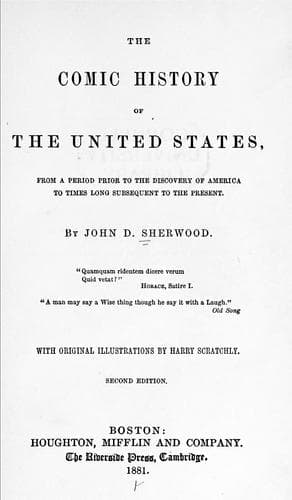
The comic history of the United States, from a period prior to the discovery of America to times long subsequent to the presentSherwood, John D.
History
The comic history of the United States, from a period prior to the discovery of America to times long subsequent to the present
Sherwood, John D.
United States -- History -- Humor
During the half-century, too, was set up that useful American music-box,
the sewing-machine,—a box that now sings joyful songs of shirts, frills,
pantaloons, and vests, in all airs, flights, and stories. In 1846 the
application of ether to lure pain into insensibility was first
discovered. The honor is contested between three Americans, an honor
large enough to be divided up, and a third given to each; but as each
naturally covets the exclusive claim, the retort-like monument to
perpetuate the discovery must be inscribed, to ether.
At the middle of the century populations had begun to gather into city
centres; 515,547 in New York; 340,045 in Philadelphia; 169,054 in
Baltimore; 136,881 in Boston; 116,375 in New Orleans; 115,436 in
Cincinnati; 77,860 in St. Louis; and in Brooklyn, un-scared by German
invasions, 96,838. Chicago, with just a score of years, had more than a
score of thousands; but its frequent doublings since have run up so many
scores, that the sum leaps the bars of all arithmetics, save its own.
Since it has taken to drinking out of Lake Michigan, and begun to draw
upon the Atlantic and Liverpool, our calculations have become so
dropsical that nothing but tapping can save them.
With greater wealth had come, of course, into America greater variety of
aspirations, tastes, modes of display, versatility of social invention
and experiment. Most of our leading public men had lived long enough to
have as many principles as they could number decades, as many heads as
the hydra, as unlike each other as in cheap weeklies, and yet at one
period or another a faithful likeness. Good-natured voters, who could
recall twenty years of ballot experience, could remember a vote given
for and against almost every Whig and Democratic chief. The country had
survived the predictions of its downfall, although, at intervals, the
New York “Evening Post” for forty-nine years, the “National
Intelligencer” for thirty-seven, the “Boston Post” for nineteen, the
“New York Herald” for fifteen, and the New York “Daily Tribune” for nine
years, had in startling type assured its readers, with most staccato
emphasis and adjectives, of its speedy overthrow, if some measure which
it reprehended was adopted, or unless some principle which it advocated
was not at once received into the national creed.
Plutocracy, of course, also, got larger Josses and re-gilded their
shrines with many fantastic patterns. Fashions enlarged and contracted,
through the five decades, with every east wind from Paris; and American
men, women, and children hastened to change the boots, hats, and
vestments, so lovely and so much admired before the last arrival, with
the same alarm after the new mode was out, as they would have doffed a
garment that had encased a cholera patient.
Fortunate then as now the feather or flower which formed a whole
tri-mestral lodgement among the native, or foreign beds of hair, that
are so beautifully upholstered one month to be taken down and ridiculed
the next.
Public-domain text, read in full here on John Shaqi.
Reviews
Reviews
No reviews yet
Be the first to share your thoughts on this work.
Elsewhere in the archive
Join the Discussion
Join the discussion
Sign in to leave a comment or review.
Sign InorCreate an account