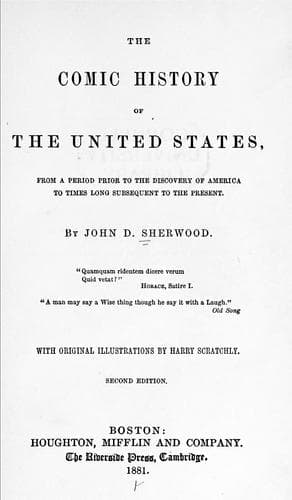
The comic history of the United States, from a period prior to the discovery of America to times long subsequent to the presentSherwood, John D.
History
The comic history of the United States, from a period prior to the discovery of America to times long subsequent to the present
Sherwood, John D.
United States -- History -- Humor
Already, however, the apple of discord, or rather a whole barrelful of
very red-faced Spitzenbergs, mixed with meal-colored russets, had been
emptied into the Union, and rolled over the floor of Congress. The
acquisitions, gained from Mexico by arms and the treaty of 1848,
including the new gold weights handed up by California, disturbed the
adjustments of Mr. Calhoun’s patent balances, which only worked well
when a colored State was put on one side at the same moment that an
uncolored one was put upon the other,—an operation about as difficult
and just as natural, as that which regulates the number of children in a
family to the number of bushels of wheat grown in any season, or to the
number of windy days in the year. In 1850, three Territories pressed for
admission as States, each carrying some of the fatal apples; California,
with a Constitution excluding slavery; New Mexico, formed out of Texas,
but disputing with her a boundary line; and Utah, then called Deseret,
taking in all the women which could be drawn thither, and, by the aid of
its dry air, absorbing them into the Smith and Young families. Texas
herself, admitted into the Union in December, 1847, always swaggering
with a rapier in her belt and a patch over her eye, bullied New Mexico
lustily on one side, so as to make lustier claims upon the United States
on the other,—a cock-eyed way of shooting that made one barrel with two
diverging eyes over the sight do the work of a double-shooter. Petitions
from the North for the abolition of slavery in the District of Columbia,
and from the South for a more stringent fugitive-slave act, rolled very
large Spitzenbergs and russets on the floor of Congress.
Looking from the legislative galleries upon the newly arrived heap, a
Western stroller might have asked of his comrade, as the freshly landed
Irishman demanded of his countrymen, at his first sight of a tortoise
walking about, “Be these live snuff-boxes common in these America; be
they or _be_ they?” and might have received a like answer, “Be asy, and
look on I tell ye, for I dunno’s they be, and I dunno _as_ they be.”
Suddenly, however, Mr. Clay’s old established omnibus, belonging to the
compromise line,—which generally took up all the passengers, rejoicing
at their good luck, although apt to set them down very discontented at
the end of the way,—drove in to carry off in one load all of these
fretting, complaining subjects.
Just at this time, July 9, 1850, the large-hearted but short-headed
President died, and the polite and urbane Fillmore,
“Washing his hands with invisible soap,
In imperceptible water,”
Public-domain text, read in full here on John Shaqi.
Reviews
Reviews
No reviews yet
Be the first to share your thoughts on this work.
Elsewhere in the archive
Join the Discussion
Join the discussion
Sign in to leave a comment or review.
Sign InorCreate an account