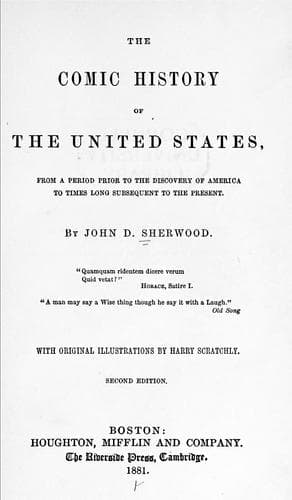
The comic history of the United States, from a period prior to the discovery of America to times long subsequent to the presentSherwood, John D.
History
The comic history of the United States, from a period prior to the discovery of America to times long subsequent to the present
Sherwood, John D.
United States -- History -- Humor
stepped out on the balcony, and, bowing suavely towards the driver and
the quarrelsome load, begged Mr. Webster, Mr. Corwin, Mr. Crittenden,
and other by-standers, to be good enough to assist in getting the
carry-all and the disagreeable objects that kept so many people awake o’
nights, out of Washington. It was not until September, however, before
the tightly crammed vehicle was started, carrying California in a State
suit, unattended by a colored servant, New Mexico, and Utah as
Territorial passengers, with the liberty of having bronzed property or
not along with them, slavers taken out of the District of Columbia never
to return, a chest containing ten million dollars for the State with a
patch on its eye, and messengers to the Northern free States, informing
them that hereafter they were to break up all underground railroads, and
to send stray Southern baggage, without its owners, back whence it had
departed.
Of course everybody was dissatisfied, except Wendell Phillips, J. Davis,
and their following,—the ascendentalists and descendentalists,—who,
sincere devotees for equality and inequality, found a novel pleasure in
having new stand-points, from which they could each look up to or down
upon, a grievance large enough for thought, speech, and action.
The political nurses, of course, thought that the paregoric had forever
quieted the crying evils; but wiser people foresaw that these attempts
to get remedies for wide-awake consciences and interests out of a
Congress-water bottle were just as idle as the conjurer’s trick to
obtain whiskey, wine cordial, brandy, and milk-punch from the same
nozzle.
In 1851 Louis Kossuth, brought over from Turkey, whither he had escaped
from Hungary in a national ship, put forth, immediately on his arrival
here, a very short catechism, which comprised a single question and
answer.
“_Q._ What is the chief end of Americans?
“_A._ To fight Austria evermore.”
After spending most eloquent commentaries upon this brief compendium of
duty, in which he braided newly spun English words and upbraided
American indifference, he abandoned the missionary field, leaving a
large Kossuth party, but a very small body of proselytes to Kossuth’s
gospel.
In 1852 we obtained an immensely large piece of japanned ware,—a
Japanese treaty bargained for by Commodore Perry,—a piece which seems to
grow larger the longer we look at it.
The death of Mr. Clay in June, 1852, and of Mr. Webster in October
following, left, like the touch of frost in autumn, a dying glory to the
troubled and storm-swept season which had just passed over America.
CHAPTER XVI.
THE UNION PIERCED; OR, PIERCE’S TURN.
1853–1857.
Public-domain text, read in full here on John Shaqi.
The comic history of the United States, from a period prior to the discovery of America to times long subsequent to the present — John Shaqi
Reviews
Reviews
No reviews yet
Be the first to share your thoughts on this work.
Elsewhere in the archive
Join the Discussion
Join the discussion
Sign in to leave a comment or review.
Sign InorCreate an account