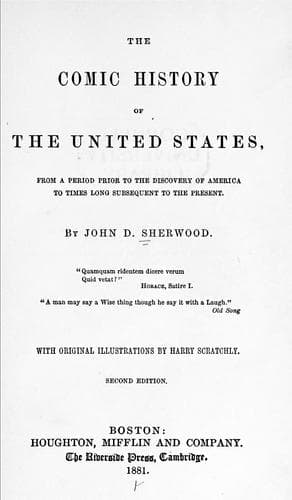
The comic history of the United States, from a period prior to the discovery of America to times long subsequent to the presentSherwood, John D.
History
The comic history of the United States, from a period prior to the discovery of America to times long subsequent to the present
Sherwood, John D.
United States -- History -- Humor
Types of American character in many respects are the originals of the
two thin-faced portraits to which we next turn,—types in their foreign
birth, their obscure social belongings, and their shrewd and successful
business ventures,—STEPHEN GIRARD, coming into life in 1750, at
Bordeaux, France, as acid as the claret of his native city, and
commanding, like it, very profitable prices by transportation to this
country, a sailor’s son, and until his nineteenth year himself a sailor;
and JOHN JACOB ASTOR, his junior by thirteen years, offspring of a
poverty-worried peasant, ushered first into a cabin at Waldorf, near
Heidelberg, where black bread and small hopped beer were all that
incessant labor could procure. The former lived eighty-one, the latter
eighty-five years upon our planet; and by faithfully gathering up from
its surface, water and land, from its ships, stores, and offices, and
from its furred and unfurred animals, the gains which persistent early
rising, industry, and ceaseless penny-turning accumulate, left fortunes,
the first of nine, the last of twenty millions of dollars.
“Sic itur ad Astra.”
The Astral-lamp Library, obtained by funds bequeathed by a benefaction,
like Girard’s College, appreciative of what its donor had himself
missed, sheds its genial light on many a poor scholar’s desk. If each
legacy has been somewhat diverted from its testamentary direction,
perhaps the best excuse may be found in the reason why married women
were not allowed to have their wills after death, because they had them
so much while living.
JOHN MARSHALL, to whose unmistakably pure-minded face we turn in safe
admiration, was one of those types of leadership, one of those
representatives of schools, who, violently liked or disliked when
living, has by the touch of death been canonized among the white-robed
of the nation. An incarnation, when alive, of Federalism, his ermine has
become so white under the fulling of time and by contrast with robes
since worn, and his grasp of the judicial balances was, as is now seen,
so firm, so unimpassioned and unshaken by a nervous partisanship, that
he has already passed into the very small list of judges, whose lofty
character, stainless purity, large judicial capacities and force, are
like solid cool rocks amid the ever-shifting scenes and temperatures of
a varied landscape.
Public-domain text, read in full here on John Shaqi.
Reviews
Reviews
No reviews yet
Be the first to share your thoughts on this work.
Elsewhere in the archive
Join the Discussion
Join the discussion
Sign in to leave a comment or review.
Sign InorCreate an account