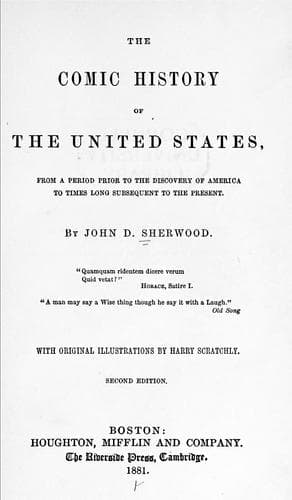
The comic history of the United States, from a period prior to the discovery of America to times long subsequent to the presentSherwood, John D.
History
The comic history of the United States, from a period prior to the discovery of America to times long subsequent to the present
Sherwood, John D.
United States -- History -- Humor
In Virginia, early in July, General George B. McClellan, then in his
thirty-sixth year, and General Rosecrans, in his forty-second,
collecting the cream of their little armies, skimmed the Confederate
pans at Rich Mountain, while immediately after, the Confederate pails
were completely upset or seized by General Morris, assisted by some help
from Ohio and Indiana, at Carrick’s Ford. General Rosecrans, flowing
towards the Southwest, came down like a mountain torrent in the Kanawha
valley, even flooding such water-logged estrays as Henry A. Wise and the
indicted Floyd. The salt springs of the valley, towards which they sped,
could not preserve them from becoming spoiled, and held ever afterward,
even by their friends, in bad odor.
A few days afterwards, the troops near Washington, numbering about
35,000 under General McDowell, were moved in a body towards the
curtain,—which was drawn back and back by its supporters to Manassas
Junction,—where Beauregard, intrenched with 27,000 men, assisted by
General Joseph E. Johnston and 16,000 more close at hand in Winchester,
steadied and upheld it. As the 35,000 thousand went forward, the three
months’ men, whose time had expired, went backward, seeking the far rear
to the sound of the enemy’s cannon, until the Federal inspecting force
was reduced to 18,000. As they approached that historic little rill,
Bull Run, they met the combined forces of the Confederates, and after
holding the field against them and even advancing upon it, until late in
the afternoon, they fell into one of those panics, not unfrequent among
troops, raw or seasoned, in which the wild run of frightened bulls or
the disordered summersaulting and tumbles of a herd of buffaloes is an
orderly march. A mass of huddling soldiers, civilians, teamsters,
members of Congress, and other muddled material was thrown upon
Washington. The puzzled Confederates, unconscious of victory and of
course unpursuing, at length got back to their capital. Discovering at
last their stupendous victory, they made up for lost time by shouts so
loud that every European echo repeated it, like a very Lurlei. In this
big scare were many of the leading generals on either side,—among those
on the Federal, Sherman, Burnside, and Heintzelman; and on the
Confederate, Longstreet, Ewell, Early, Bonham, and that praying soldier,
Stonewall Jackson, then thirty-five years old, and whose saintly,
fanatical bravery recalls the gallant slaughterers in the civil wars of
Scotland, who tempered their prayers with bayonet-pushing amens, and
ended their fervid hacking of enemies with hearty thanksgivings to
Heaven.
The losses on either side in men were nearly balanced,—the Federal dead
amounting to 481, and the Confederate to 378; the Federal wounded to
1011, the Confederate to 1489; but in prestige, self-respect, and that
subtle moral force which cannot be weighed even by grains or scruples,
the advantage was greatly with the insurrectionists.
Public-domain text, read in full here on John Shaqi.
Reviews
Reviews
No reviews yet
Be the first to share your thoughts on this work.
Elsewhere in the archive
Join the Discussion
Join the discussion
Sign in to leave a comment or review.
Sign InorCreate an account