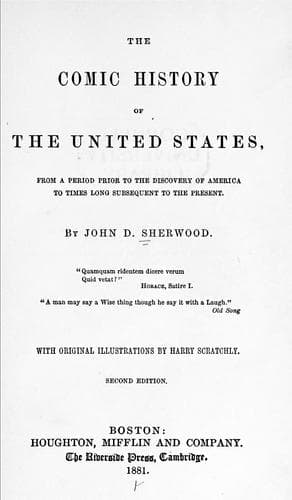
The comic history of the United States, from a period prior to the discovery of America to times long subsequent to the presentSherwood, John D.
History
The comic history of the United States, from a period prior to the discovery of America to times long subsequent to the present
Sherwood, John D.
United States -- History -- Humor
In May some Confederate cotton curtains, striped with rough military
lines, were hung before Washington. They concealed much real weakness
and want of furniture behind them, and enabled those, who kept up a
confused shouting in the darkened recesses and away from the front, to
convey an impression of numbers which did not exist.
Thirteen thousand Federal troops,—part of the seventy-five thousand,—led
by General Mansfield, desiring to get a nearer view of the curtain,
crossed over the Potomac to Arlington Heights. The Virginia soil, it was
found, no more spurned Northern feet than its cultivation was spurned by
the hands of its white owners. The next day Colonel Ellsworth, with a
Zouave regiment, entered the ancient town of Alexandria. Seeing the new
flag swaying in its sluggish air, he tore down, as he supposed, the
fetich symbol; but received almost on the instant a fatal shot, and was
borne away with slow requiems to the vast Northern cemetery, in which
new graves were soon rapidly to be opened. The struck symbol of the
Confederacy was not cut down, but only lowered to half-mast, emblem of
American hopes and pride.
May 9, Mr. Lincoln made a new call for forty-two thousand men. As
quickly as May blossoms come to the expected call of the shower they
came in rosy-hearted responses. General Butler hastened with twelve
thousand men to Fortress Monroe, whence on the 9th of June he sent a
detachment to Big Bethel. No wrestling-match, however, came off there,
and no pillar of stone, of course, set up. Meanwhile, Missouri,
Maryland, and Kentucky,—resisting the second secession cleavage, started
by Virginia, and which had drawn after her Tennessee, Arkansas, and
North Carolina,—trembled with the forces contending for ascendency in
their several borders. In the first State, General Jackson attempted in
vain to mesmerize Lyons. Failing in these passes, he made several upward
strokes, destroying railroads, bridges, and telegraph wires. But the
Federal commander, pursuing him to Boonesville, disabled his arm from
renewing such tricks. Uniting his forces with General Sigel’s,—making
from their junction six thousand men,—General Lyons attacked at Wilson’s
Creek, near Springfield, Ben McCullough and Sterling Price, with a force
of twenty thousand.
The attacking party was repulsed, and its brave leader killed, but the
followers of the Ranger were too weary to pursue them.
Public-domain text, read in full here on John Shaqi.
Reviews
Reviews
No reviews yet
Be the first to share your thoughts on this work.
Elsewhere in the archive
Join the Discussion
Join the discussion
Sign in to leave a comment or review.
Sign InorCreate an account