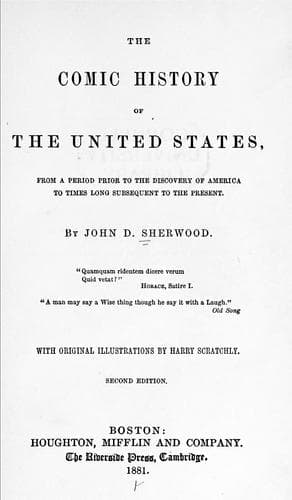
The comic history of the United States, from a period prior to the discovery of America to times long subsequent to the presentSherwood, John D.
History
The comic history of the United States, from a period prior to the discovery of America to times long subsequent to the present
Sherwood, John D.
United States -- History -- Humor
“How far is it, my boy, by this road to Drainsville?” asked a
mud-spattered traveller of a shrewd lad by the roadside. “If you keep on
the way that you are heading,” replied the boy, “and can manage the
Atlantic and Pacific on horseback, it is 23,999 miles; if you turn your
horse’s head and go right back it is one mile.”
Such were the comparative distances which the Equestrian Knights of the
Woolly Order—had they inquired on New-Year’s morning, 1862—would have
found parted them from that desirable end of their weary journey, the
pleasant village of Peace. Looking, however, only at the delusive
finger-boards which cottonized brains had set up along that way; singing
jaunty songs of Southern superiority and Northern low-down manners; and
listening to a confused distant cheer, occasionally borne to them by
certain winds out of the North and by easterly breezes from Europe, they
rode on, fancying that they would soon dismount at their journey’s end,
give their splashed animals into the accustomed charge of the old
faithful, colored ostlers, and set down to the old dishes of glorious
hominy and glorifying homily. Instead, however, of this experience, they
met interminable difficulties,—Generals Crittenden and Zollicoffer,
jostled out of saddle by General Thomas at Mill Spring, and floundering
badly through Kentucky into Tennessee; another set captured at and with
Fort Henry, February 6th, by Flag-Officer Foote, whose flotilla kept on,
as if little conscious of its impertinent doings, up the Tennessee River
as far as Florence, with encouraging shouts from loyal throats on either
bank; Fort Donelson so surrendered to the silent-lipped Grant, February
16th, and its twelve thousand men and forty pieces of cannon so
thoroughly taken up by him as to furnish no stopping-place for the tired
party; Missouri, constipated under the empiric treatment of Van Dorn and
Price, and evacuated under the drastic prescriptions of General Curtis,
too weak to entertain the travellers; Pea Ridge, Arkansas, so shelled
out by the Union pickers March 6, 7, and 8, 1862, that Ben McCullough
and numerous rangers had gone into dead silences when called upon for
help; New Madrid given up with six thousand butternut-colored troops to
the constraining faith in the American Pope; Shiloh delivered in April
to the armed Emanuel of Union expectations; Island Number Ten, in the
Mississippi, with its seven thousand hosts and vast supplies, taken
possession of April 7th, so as to afford no shelter to the equestrians;
the restoration of all Kentucky and Tennessee back into the soft bands
of the Union; the destruction of the Confederate flotilla in Albemarle
Sound, and the taking of Roanoke Island, Forts Macon and Pulaski,—these
unexpected incidents, as they advanced on the long trip, were rude
shocks to the sight, the comfort, and the spirits of the hard-whistling
equestrians. Whistle however they did and must, to keep up their courage
Public-domain text, read in full here on John Shaqi.
Reviews
Reviews
No reviews yet
Be the first to share your thoughts on this work.
Elsewhere in the archive
Join the Discussion
Join the discussion
Sign in to leave a comment or review.
Sign InorCreate an account