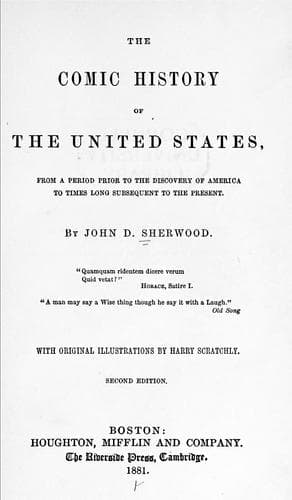
The comic history of the United States, from a period prior to the discovery of America to times long subsequent to the presentSherwood, John D.
History
The comic history of the United States, from a period prior to the discovery of America to times long subsequent to the present
Sherwood, John D.
United States -- History -- Humor
Cotton had become very mixed, and its skeins tangled and knotted.
Difficult and dark questions now travelled to Washington, and closely
besieged Mr. Lincoln. Calmly, patiently, and good-humoredly he sat down
with them in a conference to which his own good sense and large-hearted
wisdom were invited. The result was that on New-Year’s day, 1863, free
papers were plumped into the lean, slave stockings throughout all the
somehow seceded States.
During this period history and paper money were both made in large
quantities; and the paper business became very lucrative. We were
getting rich very fast after the European fashion. In the midst of the
armed clash, however, a very Pacific act was committed,—the passage in
July, 1862, of the Pacific Railroad charter, which gave one hundred
millions of reasons why the Union could not be broken. So far from
giving up the South, Congress provided for making Japan and China
American dependencies; reaching out with steel fingers for their teas,
silks, and almond-eyed live productions.
The year 1863 dawned cheerfully upon the hitherto sombre whites North,
as well as upon the more sombre sable loyalists at the South. Blockades
on the coast, a currency as depraved as Breckenridge; railroads
undulating as saws, over which phthisicy engines groaned, as they drew
the ever-lessening transportation; and a population rapidly sieved by
repeated drafts, signalled the ravages to which the Confederacy was
subjected, and its lessening means constantly clipped and pared away.
The curious stories of Mr. Davis had neither wrought a faith beyond his
own equestrian escort, nor drawn any recognition from foreign
spectators.
Little was done through the winter in the field.
Early in May, General Hooker, successor to Burnside, and the fifth
leader of the Potomac Army, having gained Lee’s rear at
Chancellorsville, kicked it severely for three hot days; but was in turn
kicked roundly. Each army lost about sixteen thousand men,—losses which,
if united, would equal the entire number of the American troops engaged
in the four principal battles of the Revolution,—Bunker Hill, Princeton,
Saratoga, and Yorktown. While this prolonged fight was going forward,
Stoneman and Kilpatrick showed some astounding feats of horsemanship, in
swinging around Fredericksburg and Richmond; cutting the Confederate
lines with such nimble swords that it delighted an enthusiastic
audience.
In June, Lee, masking large designs on Washington, Baltimore, and
Philadelphia, crossed the Potomac and showed his own face with uncounted
others at Gettysburg in Pennsylvania, where, for the first three days in
July, he was so handled by Meade, that he left 30,000 dead and wounded,
14,000 prisoners, and 27,000 stand of arms, to add attractions, that
need no special advertising to Springs that receive so much.
Public-domain text, read in full here on John Shaqi.
Reviews
Reviews
No reviews yet
Be the first to share your thoughts on this work.
Elsewhere in the archive
Join the Discussion
Join the discussion
Sign in to leave a comment or review.
Sign InorCreate an account