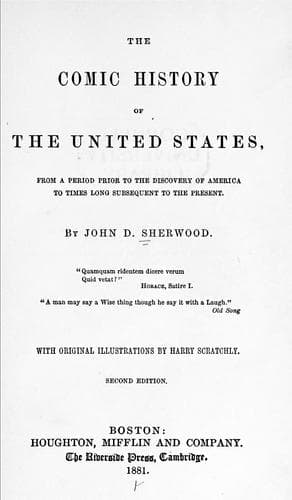
The comic history of the United States, from a period prior to the discovery of America to times long subsequent to the presentSherwood, John D.
History
The comic history of the United States, from a period prior to the discovery of America to times long subsequent to the present
Sherwood, John D.
United States -- History -- Humor
The next day, July 4, Vicksburg, fruitlessly assailed during 1862, and
beleaguered from May 4, 1863, by the reticent, self-contained,
ever-pounding, never-compounding Grant,—who had inextricably tangled it
by parallels and lines unparalleled,—surrendered its army of 30,000 men,
70,000 small arms, 200 cannon, without reckoning those dangerous
edge-tools, for the use of which its desperate gamblers had so long been
famous. Fortunately the surrender came too late to be abused by the
orators of that patient and long-suffering day.
The Mississippi River once more bore all its pipes in peace. The
mortar-boat masons, clearing away the ruins which the strikers had
caused, had prepared anew the foundations for the prosperity of that
noble valley, whose exuberant wealth is hereafter to be rolled adown it
by unshackled hands.
While the troops were absent from New York, repelling Lee’s invasion of
Pennsylvania, and the black regiments before Charleston were assisting
Gilmore to execute the stern Federal judgment upon that place, the
anti-war Irish in New York, largely left away from the front by their
own consent, gained the peaceful rear of the native-born colored men,
women, and children of that city, and took a safe hand in the only kind
of contest which they coveted. The valor which for three days they
displayed, in destroying property wholly unowned, of course, by
themselves, in chasing and hanging colored people, and in robbing all
who had watches or purses to furnish lines for their avaricious bravery
to attack, was, by a few, almost as much admired as the heroic courage
of the regiments before Charleston.
At Chattanooga, Grant, in the latter part of November, by a
heaven-touching struggle of three days, drove away the Confederate
forces out of the cloud-hidden heights of Missionary Ridge and Lookout
Mountain. From this Tabor he himself came down, but not to Bragg of the
transfiguration there.
All now admitted that cotton was very mixed and seedy.
DIVISION THIRD.
COTTON WORSTED. JANUARY 1, 1864, TO APRIL 14, 1865.
Public-domain text, read in full here on John Shaqi.
Reviews
Reviews
No reviews yet
Be the first to share your thoughts on this work.
Elsewhere in the archive
Join the Discussion
Join the discussion
Sign in to leave a comment or review.
Sign InorCreate an account