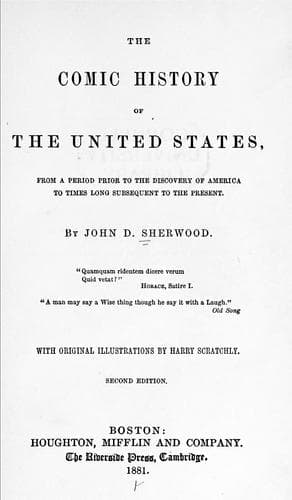
The comic history of the United States, from a period prior to the discovery of America to times long subsequent to the presentSherwood, John D.
History
The comic history of the United States, from a period prior to the discovery of America to times long subsequent to the present
Sherwood, John D.
United States -- History -- Humor
“The year of Jubal E. is come,
Return, ye wandering sinners, home.”
In the Southeast, Sherman, flanking Johnston at Dalton in Georgia,
forced him through May and June southwards, delivering battles and
defeats,—which were not ordered,—at Resaca, Dallas, Pine Lost, and
Kenesaw Mountains, until at last he shoved him behind the great southern
knob, Atlanta, whose converging iron lines held the main door of the
Lower Confederacy. Here Johnston disappeared, and the Confederate powers
put a Hood over the head of the assailed Southeast; but all in vain.
Sherman, pounding about the iron-covered Hood with heavy blows through
July and August, cleft the head-piece in two; and on the 2d of September
cast him out, and, seizing the great iron knob, opened wide the door.
On the 15th of November Sherman advanced through Georgia to the sea,
taking a swath sixty miles wide, rolling up winrows at Milledgeville,
cutting down thistles, burdocks, and noxious weeds with his well-whetted
scythe, until, on the 21st of December, he reached the farther side of
his great hay-field at Savannah. Gathering its crop into one bundle, he
despatched it to Mr. Lincoln with this epistle: “I beg to present you,
as a Christmas gift, the city of Savannah, with one hundred and fifty
guns, plenty of ammunition, and also about twenty-five thousand bales of
cotton.” Truly cotton now had become very worsted.
In June, that British scorpion, the Alabama,—which had been hatched out
at Liverpool in the spring and summer of 1862, while the British
telescope was steadily turned in another direction, and which for two
years had left its red slime all over the seas, stinging to death, as it
wriggled in its venomous course, sixty-four peaceful American
vessels,—was, by a single blow from the Kearsarge, sent to a sulphureous
grave in the Channel which washed its birthplace. Diplomatic naturalists
have ever since been disputing over the species and quality of this
reptile; while all agree, that, whether warm blooded or cold, it is not
desirable that its kind be perpetuated. Its poisonous carcass is still
coiled in offensive knots around the international diplomatic
lattice-work of the two nations.
During August, Admiral Farragut pried open the iron-set jaws of Mobile
Harbor, drawing its teeth,—Forts Morgan, Gaines, and Powell,—real molars
as they were, producing spasms which threatened lockjaw to the obstinate
patient.
While the red autumn leaves were falling through the North, Confederate
brands were whirled, some out of Canada, others from Northern cities,
upon the bank of St. Alban’s, in Vermont, on warehouses in Buffalo,
Detroit, and New York, on hotels in Cleveland, and on steamboats on the
Lakes. The real sap in the Davis tree was now running down, and the top
branches were shedding their crimson colors earthward.
Public-domain text, read in full here on John Shaqi.
Reviews
Reviews
No reviews yet
Be the first to share your thoughts on this work.
Elsewhere in the archive
Join the Discussion
Join the discussion
Sign in to leave a comment or review.
Sign InorCreate an account