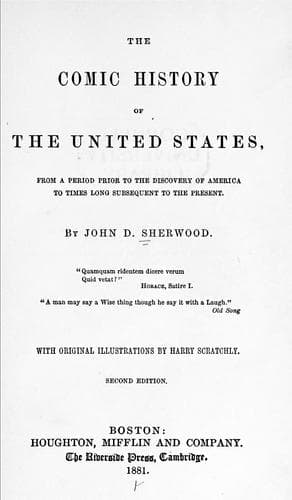
The comic history of the United States, from a period prior to the discovery of America to times long subsequent to the presentSherwood, John D.
History
The comic history of the United States, from a period prior to the discovery of America to times long subsequent to the present
Sherwood, John D.
United States -- History -- Humor
A marked improvement has also been made in the distribution of estates
generally. Among the slow nations of Europe the children generally wait
for the unfortunate old people to die before taking their property. This
tardy habit is now found to be often productive of great injury to
children, especially to those who, snatched away by rapid manners before
their begettors, are thus defrauded of their shares. “A bird in the
hand” is no longer a _rara avis_, but a domestic fowl cultivated by
rapid feeding. Gifts to the living avoid the taxes and discomforts of
probate courts, in which it is disagreeable for a family, covered with
crape, to sit and see a politician assess the estate upon the heirs.
Fast progress has been made, also, in preventive justice. Injunctions,
behind whose shields such old fogies as Lord Eldon, Lord Somers, Lord
Thurlow, John Marshall, or William Story were accustomed to hide
threatened rights until the danger was over-past, have recently been
turned edgewise, and cut down corporations and others obnoxious
Fisc-ally or otherwise, or else pressed against them so that they
perspired away their adipose stock until they were comfortably ready for
a receiver.
The doctrine of divorce, which has puzzled the learned John Miltons in
all the sleepy ages that have dozed before us, has been, in many States,
simplified, so that he who runs through them may read a decree. Some
people have uncharitably supposed that the premiums offered to
individual disunions by such States as Illinois and Indiana, were
devices to draw speculators thither for a day or so; but these are
vagrant suspicions that ought not to be allowed on our trains.
In feudal countries, where purity of blood is carefully
guarded,—inasmuch as the descents to property are the rule and not
descents from it as in America,—legists declare that a woman may not
marry her cousin, her uncle, her grandfather, or even her father,—a wise
enough restriction, perhaps, for such benighted folks, and where care in
marrying often leaves the female part of the household to the dangerous
company of these relations until far on in life. But with us women are
not shut up to any such necessities, except in Utah, where they may, in
the course of a respectably long life, marry through every genealogical
degree without knowing it. In other parts they are as necessary as
insurance companies, and so marry very soon; so that silver weddings are
often seen at an early age, while golden matrimonies are more frequent
than maternities or patrimonies. To every thoughtful man, who moves
about our rapidly dissolving surfaces, where the railroad car is the
kaleidoscope which turns up the bits of humanity in new combinations, a
wife is necessary to put up a monument over him; for moving on is such a
fixed law,—the only fixed thing in America, except debt and live
corruption,—that while he was turning his majority, all his family
relations would have gone to other States.
Public-domain text, read in full here on John Shaqi.
Reviews
Reviews
No reviews yet
Be the first to share your thoughts on this work.
Elsewhere in the archive
Join the Discussion
Join the discussion
Sign in to leave a comment or review.
Sign InorCreate an account