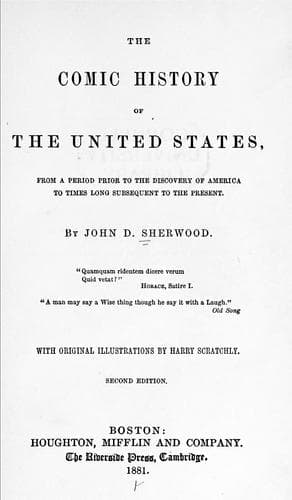
The comic history of the United States, from a period prior to the discovery of America to times long subsequent to the presentSherwood, John D.
History
The comic history of the United States, from a period prior to the discovery of America to times long subsequent to the present
Sherwood, John D.
United States -- History -- Humor
American stomachs have not time enough to wait on nature. Hence doctors’
gigs and apoplectic whirligigs. A patent stomach that should grind grist
for a neighborhood or village, and leave the unstomached worker to avail
himself of his accelerating opportunities, would command a high price.
It would be hired out around the neighborhood, like a threshing-machine
or corn-sheller. In fact, American households might in general be
advantageously grouped around or framed into one of these mechanical
digesters, with attachments for washing out, ironing, and starching
their clothes, and for doing up the wasteful processes of visiting, to
economic advantages that would tell on the census. One of the
disadvantages would be the discouragement of that branch of American
industry, now so largely prosperous, of doctors’ bills, chasing in vain
after many of the living and at last only overtaking the administrator
of the estate, clean out of breath.
Of course, the benefits of associated wealth and skill have not been
overlooked as levers to move enterprises, people’s purses, and sometimes
those low-down, coarse adjectives, volcanic in their origin, which, in
case of dissatisfaction, erupt over the surface. Universal
clothes-wringers are the product of this observation. So other
combinations have been and are rapidly forming to wring money out of
city, State, and Federal exchequers. It is curious to see how the
handles of these joint pumping and pocket-exhausting companies all lie
towards the great cities.
Most of the business in the United States, north of Washington, is
carried on after an express and accelerated fashion, which is impatient
of holidays, and rides over the Fourth of July even, as ruthlessly as an
express-train over the human obstruction which thus gets forwarded on
his journey out of the United States with a despatch almost enviable to
the survivors. Even the Federal Constitution prescribes “speedy trials”
as a right, and treats a man as injured who does not go it in a capital
way, when on that precipitous road, with a final rush.
The common law of the United States presumes that all are minute-men,
and know the quick step; while the uncommon law in Wyoming, Idaho,
Nevada, and Colorado dispenses with the tedious confinement between the
apprehension of the accused and his transporting sentence and uprising.
“Delays are dangerous,” is their condensed code.
[Illustration:
MEMBERS OF CONGRESS IN A. D. 1900.
(p. 520)
]
The law of dower, as practically enforced, is shaped by the same rapidly
revolving lathe, which makes so much of our domestic hollow-ware. The
wife spends the principal before her husband’s death, and thus shuns the
tedious complications of legal proceedings, which admeasures the dower
often to the enterpising lawyer, the bailiffs, and the court clerks.
Public-domain text, read in full here on John Shaqi.
The comic history of the United States, from a period prior to the discovery of America to times long subsequent to the present — John Shaqi
Reviews
Reviews
No reviews yet
Be the first to share your thoughts on this work.
Elsewhere in the archive
Join the Discussion
Join the discussion
Sign in to leave a comment or review.
Sign InorCreate an account