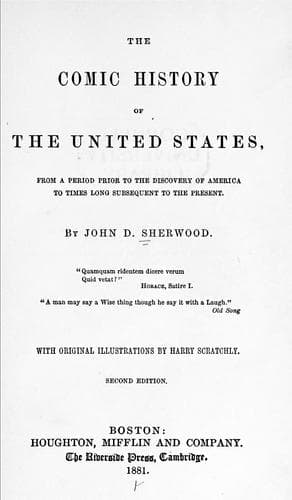
The comic history of the United States, from a period prior to the discovery of America to times long subsequent to the presentSherwood, John D.
History
The comic history of the United States, from a period prior to the discovery of America to times long subsequent to the present
Sherwood, John D.
United States -- History -- Humor
The happy results of this change will be apparent—to any infant mind.
Short-jacketed M. C.’s will impart new vivacity to Congressional debate;
young ministers to foreign courts will be able to acquire, if they do
not know, some language beside the American, and be able to converse
with those with whom they have business,—an un-speakable luxury now.
Active, bustling infants will give a new ardor to journalism, and
produce a more enterprising corps of wide-awake, newspaper
correspondents, to keep up the stock of telegraph companies by
information which, being constantly in advance of the facts, would
fairly represent and be fitting types of, the infantile correspondents
themselves, and necessitate additional contradictions. As territorial
governors, obliged to take hazardous journeys on our railways,—which
often intervene and prevent older men from reaching their
destination,—they would be nimble enough to get out of the wreck, or
perhaps smart enough to keep their deaths secret, and have their
ancestors draw their salary,—thus accomplishing, although not present,
the principal business of that office. Then, too, how much livelier
would things go on in our churches, if, instead of the dull, old elders,
deacons, or vestrymen, now seldom elected before they reach the great
age of thirty, and who, when they were boys, were smart enough, although
not as alert as their own boys now, were allowed to rest their stiffer
awkward limbs in their pews, and ecclesiastical affairs were managed by
their youngers? The sick would be visited by cheerful, round-faced
persons, bright with the health which would be brought as a living fact
to the invalid; widows would be comforted by the presence of dark-haired
and hopeful youths, and not depressed by the aspect of people encumbered
with wives and the chilling experience of at least a score and a half of
years; while the poor would receive liberally from those who well know,
that the best use for money is to keep it in vigilant circulation.
[Illustration:
SCHOOL TEACHING FROM 1869 ONWARDS.
(p. 542)
]
Business would also be conducted on youthful principles, in consonance
with the other rapid ways of the times; capital would be nimble and
alert, creating profits so lively that they would leap back into the
common and rapidly running current. Old legislative peculators, bank and
trust defaulters, would soon, in the natural course of things, and
without the shocks of legal trials,—which generally produce no
results,—be displaced; while young iniquity would scarcely acquire the
rime and rust which now incrust so many of the old instruments of
corruption, making them almost respectable. Biographies, now often
running tediously through so many chapters, would be brief; as an
American life might be assumed to close up substantially at twenty-five
at least, and we should get the rich morning cream, without wearying
ourselves with collecting the thin globules that float on the pan of
age.
Public-domain text, read in full here on John Shaqi.
Reviews
Reviews
No reviews yet
Be the first to share your thoughts on this work.
Elsewhere in the archive
Join the Discussion
Join the discussion
Sign in to leave a comment or review.
Sign InorCreate an account