Produced by Stuart E. Thiel
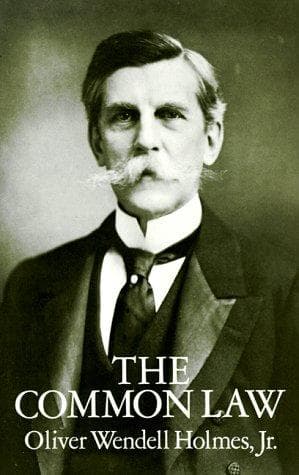
THE COMMON LAW
By Oliver Wendell Holmes, Jr.
Conventions:
Numbers in square brackets (e.g. [245]) refer to original page
numbers. Original footnotes were numbered page-by-page, and are
collected at the end of the text. In the text, numbers in slashes
(e.g./1/) refer to original footnote numbers. In the footnote
section, a number such as 245/1 refers to (original) page 245,
footnote 1. The footnotes are mostly citations to old English law
reporters and to commentaries by writers such as Ihering, Bracton
and Blackstone. I cannot give a source for decrypting the
notation.
There is quite a little Latin and some Greek in the original
text. I have reproduced the Latin. The Greek text is omitted; its
place is marked by the expression [Greek characters]. Italics and
diacritical marks such as accents and cedillas are omitted and
unmarked.
Lecture X has two subheads--Successions After Death and
Successions Inter Vivos. Lecture XI is also titled Successions
Inter Vivos. This conforms to the original.
LECTURE I. -- EARLY FORMS OF LIABILITY.
[1] The object of this book is to present a general view of the
Common Law. To accomplish the task, other tools are needed
besides logic. It is something to show that the consistency of a
system requires a particular result, but it is not all. The life
of the law has not been logic: it has been experience. The felt
necessities of the time, the prevalent moral and political
theories, intuitions of public policy, avowed or unconscious,
even the prejudices which judges share with their fellow-men,
have had a good deal more to do than the syllogism in determining
the rules by which men should be governed. The law embodies the
story of a nation's development through many centuries, and it
cannot be dealt with as if it contained only the axioms and
corollaries of a book of mathematics. In order to know what it
is, we must know what it has been, and what it tends to become.
We must alternately consult history and existing theories of
legislation. But the most difficult labor will be to understand
the combination of the two into new products at every stage. The
substance of the law at any given time pretty nearly [2]
corresponds, so far as it goes, with what is then understood to
be convenient; but its form and machinery, and the degree to
which it is able to work out desired results, depend very much
upon its past.
In Massachusetts today, while, on the one hand, there are a great
many rules which are quite sufficiently accounted for by their
manifest good sense, on the other, there are some which can only
be understood by reference to the infancy of procedure among the
German tribes, or to the social condition of Rome under the
Decemvirs.
Public-domain text, read in full here on John Shaqi.
Reviews
Reviews
No reviews yet
Be the first to share your thoughts on this work.
Join the Discussion
Join the discussion
Sign in to leave a comment or review.
Sign InorCreate an account