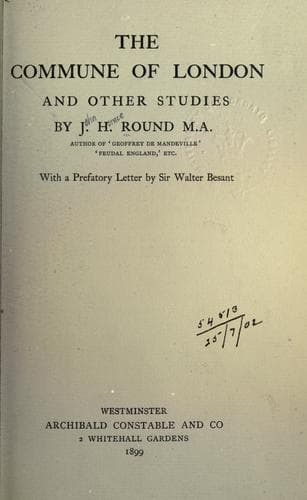
The Commune of London, and other studiesRound, John Horace
History
The Commune of London, and other studies
Round, John Horace
Great Britain -- History -- Norman period, 1066-1154; London (England) -- History -- To 1500
I do not say that I agree with the argument: it could, I think,
scarcely be weaker. But the point is that Pope Alexander, in the letter
given by Giraldus, and asserted by him to have been sent in reply to
the letters from the Council of Cashel (1171–2), is represented as
confirming the “Bull of Adrian” “salva beato Petro ... de singulis
domibus annua unius denarii pensione.” That is to say that, if the
letter is genuine, he did exactly what Miss Norgate assures us he would
not have done. It follows then, from her own argument, that the letter
cannot be genuine.[407]
I must here again remind the reader of the cardinal point in my case,
namely, that Giraldus has been misunderstood as assigning to “1175” the
despatch of the Pope’s “privilegium,” whereas his narrative clearly
shows that he treats that “privilegium” as obtained by Henry in reply
to the report of the Council of Cashel (1171–2) and as the Papal
sanction of what he had done in Ireland. That the king was anxious to
obtain this sanction, and to publish it, when obtained, as soon as
possible, we may readily believe. But that he obtained it as soon as
possible, and, having done so, made no use of it till he suddenly,
in “1175,” despatched it to Ireland _à propos de bottes_, is an
unintelligible hypothesis. In any case, we are confronted with the fact
that both the “privilegium”[408] and the Black Book letter purport to
have been despatched from Rome in reply to Henry’s mission. But they
could not both be the Pope’s reply: one or the other must be false.
This being so, we need not hesitate to decide in favour of the Black
Book letter; for the “privilegium” given by Giraldus is virtually
abandoned, we have seen, even by Miss Norgate.
The conclusion, then, at which we arrive is that Giraldus substituted
for the true reply of the Pope a false one merely confirming the “Bull”
Laudabiliter. From this conclusion we advance to the question whether,
if he was capable of concocting (or giving it currency when concocted)
a spurious letter of Alexander, he was not also capable of concocting
(or giving it currency when concocted) that letter of Adrian, which he
published with it, in the ‘Expugnatio,’ and which, in fairness, must be
treated as inseparable from it.[409]
We saw clearly at the outset that he can have had no scruple as to
inserting in his narrative--I will not say a forged document, but
one of which the text was the work of his own pen. On this point,
therefore, we need not hesitate. We may proceed then to enquire whether
Henry II. was likely to keep silence as to Adrian’s “Bull” when he
entered Ireland--the very time when he might be expected to make use of
it--and then produce it at a subsequent time with no particular reason.
Two propositions are here involved. As to the first Father Gasquet has
observed:
Public-domain text, read in full here on John Shaqi.
Reviews
Reviews
No reviews yet
Be the first to share your thoughts on this work.
Elsewhere in the archive
Join the Discussion
Join the discussion
Sign in to leave a comment or review.
Sign InorCreate an account