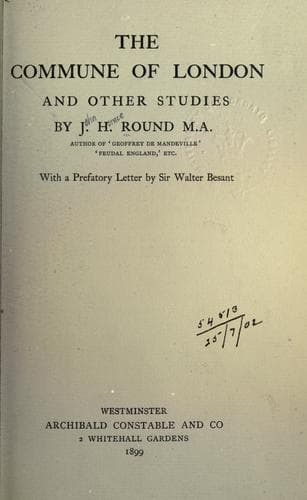
The Commune of London, and other studiesRound, John Horace
History
The Commune of London, and other studies
Round, John Horace
Great Britain -- History -- Norman period, 1066-1154; London (England) -- History -- To 1500
It was of vital importance when he went over to receive the
homage of the Irish, and could never have been withheld or
concealed at the Council of Cashel in 1172, at which the Papal
legate presided.[410]
Father Burke, whom he quotes, has bluntly insisted on the fact; and
Father Morris has similarly dwelt on the king’s suspicious silence.
So great, indeed, is the difficulty of supposing that Henry made no
mention of the “Bull” at the very time when, if ever, he was likely to
make use of it, that Miss Norgate wrote as follows, in her ‘England
under the Angevin Kings’ (ii. 115):
We hear not a word of Pope Adrian’s bull, but we can hardly
doubt that its existence and its contents were in some way or
other certified to the Irish prelates before ... they met in
council at Cashel in the first weeks of 1172.
Going even further, in another passage (ii. 81), she boldly spoke of
Henry’s “conquest won with Adrian’s bull in his hand.” And yet, when
afterwards, in her article, she wished to deny the difficulty, she
could turn round and confidently urge that “Henry said nothing about
the Pope’s letter, because it was a matter of no practical consequence
whatever.”[411] Such a _volte-face_ as this does not tend to inspire
confidence in her arguments. But even if we accept this, her later
conclusion, it only increases the difficulty of explaining why Henry
II. formally made the “Bull” public a year or two later (and still
more, why he should have done so, as she holds he did, in “1175”). And
this difficulty, so far as I can find, she does not attempt to meet.
Everything then, it seems to me, points to the clear conclusion that
Giraldus substituted for the genuine letters from the Pope, in the
‘Liber Niger,’ a concocted confirmation of an equally concocted “Bull”
from his predecessor Adrian.
Having arrived at this conclusion, I propose to ask three questions:
(1) Why did Giraldus do this?
(2) How were his documents concocted?
(3) Was there a conspiracy, in which Giraldus
joined?
As to the Welshman’s motive, it has been urged by his critics that he
wished to gratify the king. Miss Norgate retorts:
At no period of his life is it likely that Gerald would have
had any personal interest in putting in circulation, for King
Henry’s benefit, a document which he knew or suspected to be
forged; least of all would he have cared to do it for the sake
of bolstering up Henry’s claims upon Ireland.[412]
But whatever may have been his personal feelings towards Henry II. his
eagerness to prove the right of the English Crown to Ireland is one of
the leading features of his ‘Expugnatio Hiberniæ.’ He sets forth more
than once the arguments on which he bases it, and he treats the Papal
action as the crowning argument of all:
Public-domain text, read in full here on John Shaqi.
Reviews
Reviews
No reviews yet
Be the first to share your thoughts on this work.
Elsewhere in the archive
Join the Discussion
Join the discussion
Sign in to leave a comment or review.
Sign InorCreate an account